
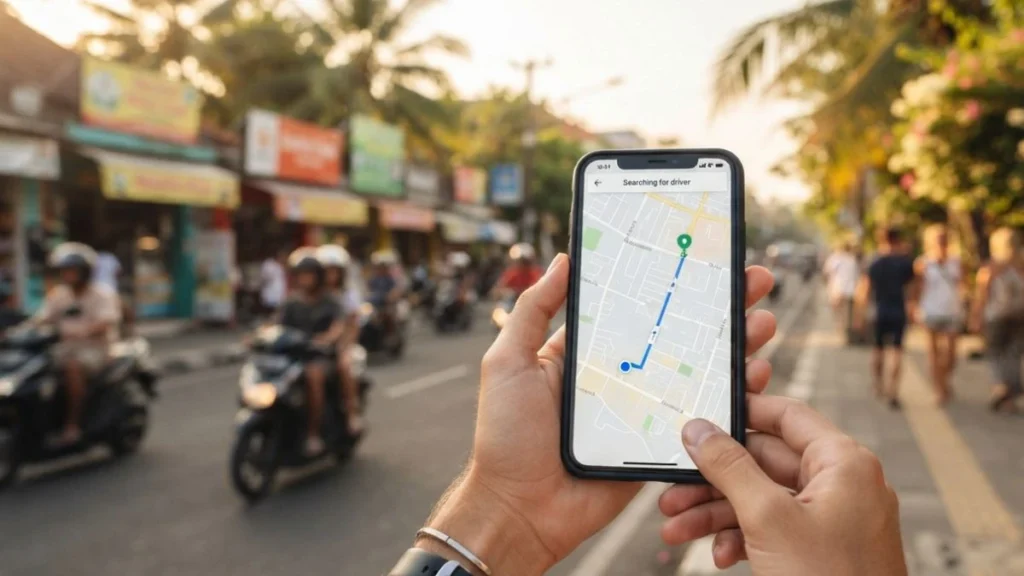
Grab and Gojek in Bali work exactly like you’d expect almost everywhere on the island — open the app, drop a pin, get a fixed upfront price, no haggling. Then you land in central Ubud or parts of Canggu, order a ride, and your driver asks you to walk to a spot a few minutes away instead of picking you up where you’re standing. That’s not a bug or a scam. It’s a real, long-running arrangement between ride-hailing apps and local transport cooperatives, and knowing about it before it happens saves a genuinely confusing moment mid-trip.
This guide covers where the apps work perfectly, where they don’t, and what to do instead when you land in one of the restricted zones.
Quick Facts
- Excellent, reliable coverage: Nusa Dua, Jimbaran, Kuta, Legian, Seminyak, Canggu (mostly), Sanur, Denpasar, and central Ubud generally
- Restricted “no-go” zones: specific pockets of central Ubud (around Ubud Palace, the Monkey Forest, Jalan Hanoman) and parts of Canggu, where local transport cooperatives limit direct app pickups
- What happens in a restricted zone: your driver may ask you to walk to a short “buffer zone” a few minutes away, or cancel the ride entirely
- Best backup option in blocked areas: Bluebird, Bali’s official metered taxi service, which retains pickup access in more places than app-based rides
- Public transport: limited but not nonexistent — Kura-Kura Shuttle, Trans Metro Dewata, and SARBAGITA buses cover some fixed routes, though most tourists still rely on apps, scooters, or private drivers
Why Certain Areas Block App Pickups
This isn’t random or malicious — it comes from formal agreements between ride-hailing companies and local banjar-based transport cooperatives, the traditional community transport groups that operated in these areas long before Grab or Gojek existed. In designated zones, particularly central Ubud’s most tourist-dense stretches, app-based drivers are restricted from picking passengers up directly, specifically to avoid undercutting the livelihood of local drivers who’ve historically served these exact routes. It’s a genuine, long-standing local economic protection arrangement rather than an app malfunction or a scam targeting tourists.
Because of this, don’t be surprised if a Grab or Gojek driver cancels your ride once they see your pin is inside one of these zones, or messages you asking to meet at a nearby main road instead of your exact location. It’s not personal, and arguing with the driver won’t change the underlying arrangement — walking the short distance is generally the path of least resistance.
What to Do When You’re in a Restricted Zone
A few practical options work well here. First, simply walking a few minutes to a nearby main road or a slightly less restricted spot often resolves it entirely — many drivers will tell you exactly where to meet them if you ask through the app’s chat function. Second, Bluebird’s light-blue metered taxis remain one of the more reliable options that can still pick up directly in some areas where app-based rides are blocked, making them a solid backup specifically for these situations rather than a first choice everywhere. Third, if you’re staying at a hotel or guesthouse within a restricted zone, ask staff directly — many properties have an arrangement with local drivers or can call one for you without the app-blocking issue applying at all.
For day trips or longer routes where you’ll be moving between several stops, booking a private driver for the day sidesteps the zone issue completely, since you’re not relying on app-based pickup logistics at every stop.
Coverage Beyond the Restricted Zones
Outside these specific pockets, Grab and Gojek work reliably across the vast majority of tourist Bali — South Bali’s main areas (Nusa Dua, Jimbaran, Kuta, Legian, Seminyak), Sanur, Denpasar, and most of central Ubud outside the tightest restricted core, all see solid app availability. The bigger limitation as you head further out isn’t zone restrictions but simple coverage: remote rural areas, mountainous regions, and smaller villages often have patchy app availability regardless of any local agreement, since drivers are less willing to travel long distances for a single pickup in areas with low return-trip demand.
Other Options Worth Knowing
Maxim is Bali’s ultra-budget ride-hailing alternative, genuinely cheap but with a clunkier app experience and drivers who may have less reliable English or GPS navigation — workable if you’re tracking every rupiah, but worth tempering expectations. Traditional ojek (informal motorbike taxi) drivers still operate in tourist-heavy spots, often waiting outside clubs, markets, or busy corners, and can be a reasonable option for a short, simple hop if you’re comfortable negotiating a price directly rather than using an app.
FAQ
Are Grab and Gojek illegal in parts of Bali?
No, the apps themselves are legal everywhere in Bali. Certain zones have informal agreements limiting direct pickups to protect local transport cooperatives, but using the app to book from just outside those zones works fine.
Which areas in Ubud have Grab and Gojek restrictions?
The tightest restrictions apply around Ubud Palace, the Monkey Forest area, and Jalan Hanoman. Outside this core, coverage is generally more reliable.
What should I do if my Grab or Gojek driver cancels near Ubud Palace or Monkey Forest?
Walk a short distance to a nearby main road, or check the app’s chat for a suggested meeting point. Bluebird taxis are a reliable backup option in these specific areas.
Is Bluebird more reliable than Grab or Gojek in restricted zones?
Generally yes, for pickup access specifically — Bluebird retains the ability to pick up in more locations than app-based ride-hailing in Bali’s most restricted tourist zones.
Is public transport a realistic option in Bali?
It’s limited but exists — Kura-Kura Shuttle, Trans Metro Dewata, and SARBAGITA buses cover some fixed routes, though most travelers still rely primarily on ride-hailing apps, scooters, or private drivers for flexibility.
Final Thought
Grab and Gojek in Bali work smoothly almost everywhere, and the pockets where they don’t come down to a genuine local arrangement rather than anything broken about the apps themselves. Know the restricted zones in Ubud and parts of Canggu going in, keep Bluebird’s number or app handy as a backup, and a short unexpected walk becomes a minor inconvenience rather than a confusing surprise. For more on getting around Bali beyond ride-hailing apps, our guides to renting a motorbike and getting around without a tour cover the rest of your transport options.