
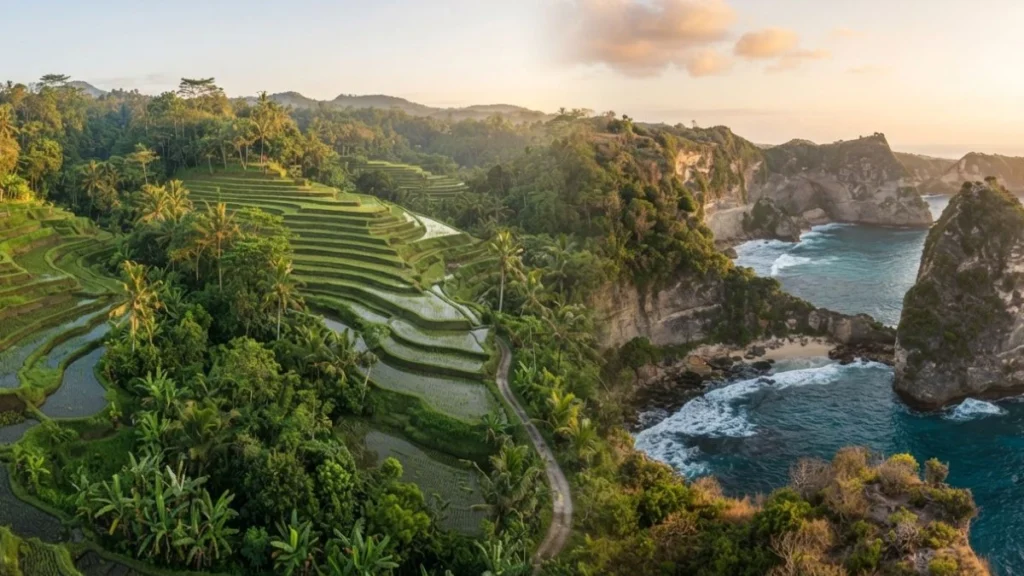
Ubud vs Uluwatu is the comparison that comes up once you’ve ruled out the beach-party version of Bali and the jungle-and-temples version both feel too limiting on their own. These are genuinely opposite ends of the island’s personality — one inland and green, the other coastal and dramatic — and unlike Ubud vs Canggu, this isn’t really a question of pace so much as a question of whether your trip revolves around the ocean or not.
This guide breaks down what each actually offers, who they suit, and the honest trade-offs worth knowing before you commit.
Quick Facts
- Distance apart: roughly 1.5–2 hours by car, given Uluwatu’s position on the southern Bukit Peninsula
- Ubud: inland, jungle and rice terrace scenery, wellness and cultural focus, no beach access
- Uluwatu: clifftop coastline, world-class surf breaks, beach clubs, dramatic sunsets
- Cost: Uluwatu generally runs pricier than Ubud, especially for clifftop stays and big-name beach clubs
- Terrain: Ubud is relatively flat and walkable in the town center; Uluwatu is hilly, with steep paths down to most beaches
Two Completely Different Versions of Bali
Ubud is inland, built around rice terraces, jungle walks, temples, and a wellness culture this site has covered in depth — quiet evenings, boutique jungle villas, and a rhythm oriented toward culture and nature rather than the ocean. Uluwatu sits on the opposite end of that spectrum entirely: towering limestone cliffs on the Bukit Peninsula, some of the best surf breaks in the world, and sunset views over the Indian Ocean that consistently rank among Bali’s most dramatic. It’s also home to Uluwatu Temple itself and the nightly Kecak Fire Dance, giving it a cultural anchor point of its own alongside the surf and beach club scene.
The honest framing here, echoed across most comparisons of the two: Ubud is not a beach base, and Uluwatu is not where you go for immersive cultural depth. Neither area does what the other does well, and travelers who try to force one into covering both needs tend to end up disappointed by whichever half of the trip doesn’t fit.
Cost and Development
Uluwatu was, until fairly recently, a quiet surf hideout — that’s changed considerably, with more traffic, more construction, and noticeably higher prices than a decade ago, particularly around the clifftop villas and big-name beach clubs that have moved in. It now generally costs more than both Ubud and Canggu for comparable accommodation, especially if you’re staying cliffside or spending your days at the well-known beach club circuit. Ubud, by comparison, still offers a wider range of price points, from simple homestays to luxury wellness resorts, without the same premium attached to “the view.”
Who Each Place Actually Suits
Choose Ubud if culture, temples, rice terraces, wellness, and a slower inland rhythm define what you want out of the trip — it remains, by most accounts, the area that best matches what people picture when they first imagine “Bali” as a cultural destination. Choose Uluwatu if the ocean is the whole point: surfing, cliffside sunset drinks, and a coastal, resort-town feel that leans more relaxed than Canggu but still delivers a genuine scene once the sun goes down. Surfers specifically tend to favor Uluwatu for its combination of world-class breaks and, relative to Canggu, comparatively minimal infrastructure demands — you don’t need much beyond a board and a place to sleep.
Neither is inherently the “better for families” option in the way Sanur is — Uluwatu’s terrain (steep cliff access to most beaches) and Ubud’s lack of any beach at all mean families weighing this specific pairing should think carefully about what a typical day with kids actually looks like in either location.
Combining the Two
Given the roughly 1.5- to 2-hour drive between them, Ubud and Uluwatu combine reasonably well into a longer trip, typically as two distinct legs rather than a single base — several days inland in Ubud for culture and nature, followed by several days on the Bukit Peninsula for surf, cliffs, and sunset. This mirrors the same logic behind pairing Ubud with Canggu or Sanur: rather than compromising on either experience, splitting the stay lets each half of the trip do what it’s actually good at.
FAQ
How far is Uluwatu from Ubud?
Roughly 1.5 to 2 hours by car, given Uluwatu’s position on the southern tip of the Bukit Peninsula, well outside Ubud’s inland location.
Is Uluwatu more expensive than Ubud?
Generally yes, particularly for clifftop accommodation and the well-known beach club circuit. Ubud offers a broader range of price points overall.
Which is better for surfing, Ubud or Uluwatu?
Uluwatu, without question — it’s home to some of the best surf breaks in the world. Ubud is fully inland with no beach or surf access at all.
Is Uluwatu good for families?
It can be, but the terrain is genuinely hillier than Sanur, with steeper paths down to most beaches. Families prioritizing calm, easy beach access may find Sanur a better fit than either Ubud or Uluwatu.
Can I visit both Ubud and Uluwatu on one trip?
Yes, and it’s a commonly recommended structure — several days inland in Ubud followed by several days on the coast in Uluwatu, treated as two distinct legs of the trip rather than a single combined base.
Final Thought
Ubud and Uluwatu aren’t really competing for the same traveler — one is Bali’s cultural and wellness heart, the other its most dramatic stretch of coastline. If your trip genuinely needs both, splitting your stay gets you the best of each rather than a compromised version of one. For more on how Uluwatu’s temple and sunset scene actually works, our Uluwatu Temple guide covers the details, and our Ubud vs Canggu and Ubud vs Sanur comparisons round out the rest of the island’s main bases.