
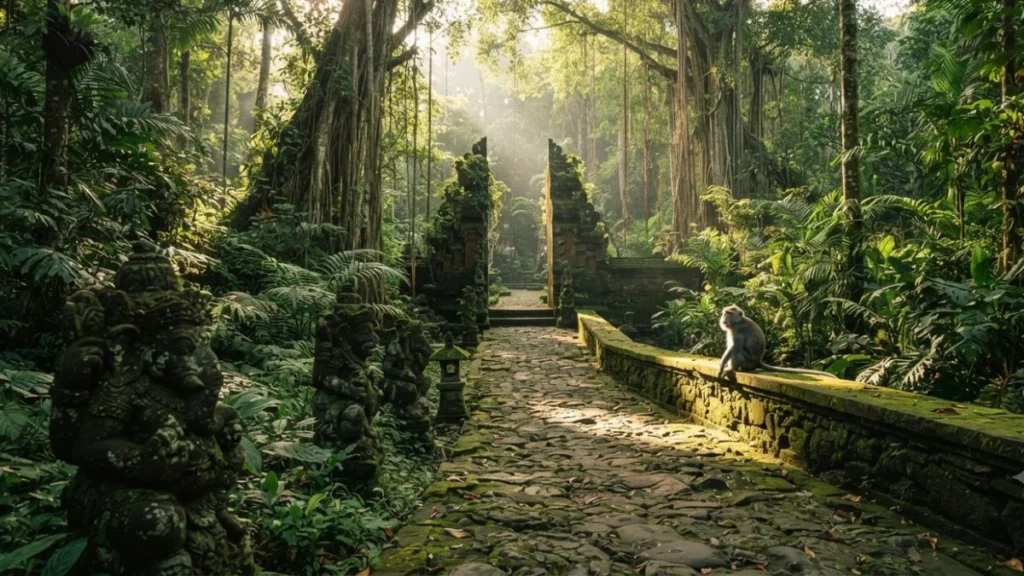
The Ubud Monkey Forest, officially the Sacred Monkey Forest Sanctuary, is one of the few attractions in town that lives up to its own hype — a 12.5-hectare jungle reserve in Padangtegal village, home to roughly 1,200 free-roaming long-tailed macaques and three genuinely significant 14th-century temples. It’s also a place where the safety rules matter more than most tourist attractions, and getting bitten or scratched here is common enough that it’s worth understanding the actual protocol before you go rather than after.
This guide covers the practical details — fees, hours, what to expect — plus the honest version of the rabies question that comes up in nearly every online forum about this place.
Quick Facts
- Official name: Sacred Monkey Forest Sanctuary (Mandala Suci Wenara Wana), Padangtegal village
- Size: 12.5 hectares, home to roughly 1,200 long-tailed macaques in about 10–12 social troops
- Hours: 9am–6pm daily, last entry around 5–5:15pm
- Entrance fee (2026): roughly IDR 80,000 for adults, IDR 100,000 for children (6–11), rising most years
- Location: Jalan Monkey Forest, an easy walk from central Ubud
- Temples inside: three 14th-century sites, including Pura Dalem Agung Padangtegal, a holy spring temple, and a cremation temple used for ceremonies every five years
What’s Actually Inside
Beyond the monkeys, the Ubud Monkey Forest is a working sacred site for the local Padangtegal community, built around the Balinese Hindu philosophy of Tri Hita Karana — balance between people, nature, and the divine. Stone paths wind through dense jungle past moss-covered statues, carved demon guardians (Bhoma), and small wooden bridges over a stream cutting through the reserve. The main temple, Pura Dalem Agung Padangtegal, dates to roughly 1350 AD and is generally off-limits to tourists beyond viewing from outside the gate, along with a spring temple used for purification and a cremation temple that holds a major ceremony only once every five years.
Most visitors spend one to two hours here, which is enough to walk the main paths, see the temple exteriors, and spend time watching the monkeys without rushing.
The Rabies Question, Honestly Answered
This comes up in nearly every online discussion of the Ubud Monkey Forest, so here’s the straight answer: there has never been a recorded case of rabies transmission at the sanctuary, and the monkey population is monitored regularly by researchers, including scientists affiliated with Udayana University’s Primate Research Center. In 2023, Bali authorities began a precautionary mass vaccination program for the monkeys, adding another layer of protection on top of the existing research monitoring.
That said, “never recorded” isn’t the same as “impossible,” and the responsible advice from medical clinics in the area is consistent: any bite or scratch that breaks the skin should be washed thoroughly with soap and running water for a full 15 minutes, then followed up with a visit to a local clinic for a professional evaluation, which may include a tetanus shot and rabies post-exposure treatment as a precaution. Monkey bites happen often enough here that most visitors who get one don’t seek treatment and are fine — but “probably fine” isn’t the same as a guarantee, and rabies has no cure once symptoms begin. Treat any broken skin seriously rather than shrugging it off, regardless of how low the actual risk has proven to be.
How to Avoid Trouble in the First Place
Most negative encounters happen because visitors bring or carry things the monkeys want. Leave food, drinks, and plastic or paper bags out of the forest entirely — the monkeys are highly skilled at identifying and grabbing anything that looks like it might contain a snack. Loose items like sunglasses, hats, and water bottles are also common targets; keep bags zipped and cross-body rather than open or slung over one shoulder, and consider using the entrance lockers for anything you’re not prepared to lose.
If a monkey does jump on you or grab something, staff guidance is consistent: stay calm, don’t panic or try to fight it off, and notify a staff member rather than attempting to retrieve an item yourself. Aggressive or panicked reactions are what tend to escalate a monkey’s response into biting or scratching.
Getting the Photo Without the Risk
Self-serve monkey selfies aren’t allowed, and for good reason — the sanctuary runs a supervised “Monkey Moment” service where staff lure a calm monkey over with a small snack and help you get the photo safely, usually included with entry or available for a small additional fee. There are also paid add-ons for a guided professional photo session or an Instax instant camera rental if you want a more polished set of photos from the visit. Skip trying to coax a monkey over yourself — it’s against the rules and more likely to end with a scratch than a good photo anyway.
Practical Visit Tips
Wear closed walking shoes and modest, comfortable clothing suitable for a site that’s part sacred temple complex, part jungle reserve. Arrive earlier in the day if you want to avoid the busiest midday hours, and note that last ticket entry is around 5 to 5:15pm even though the gates stay open until 6pm. Cash, credit cards, and bank cards are all generally accepted at the entrance, though it’s worth carrying some cash as a backup in case of payment system issues.
FAQ
How much does it cost to enter the Ubud Monkey Forest?
As of 2026, roughly IDR 80,000 for adults and IDR 100,000 for children aged 6–11, with prices typically rising slightly each year.
Is there rabies at the Ubud Monkey Forest?
No case has ever been recorded, and the monkey population is monitored by researchers and has undergone precautionary vaccination since 2023. Still, treat any bite or scratch that breaks skin seriously — wash thoroughly and get it checked at a clinic, since rabies has no cure once symptoms appear.
What should I avoid bringing into the Monkey Forest?
Food, drinks, plastic or paper bags, and any loose valuables like sunglasses or hats that a monkey could easily grab. Keep bags zipped and secured, or use the entrance lockers.
Can I take a selfie with the monkeys myself?
Not directly — the sanctuary runs a supervised photo service where staff safely bring a monkey over for you rather than allowing visitors to approach or lure monkeys on their own.
How long should I plan to spend at the Ubud Monkey Forest?
Most visitors spend one to two hours exploring the paths, temples, and watching the monkeys, though you’re welcome to stay until closing with a valid ticket.
Final Thought
The Ubud Monkey Forest earns its place on nearly every Ubud itinerary, but it rewards visitors who take the rules seriously rather than treating it like a petting zoo. Keep your belongings secured, stay calm around the monkeys, and get any bite or scratch checked properly rather than assuming it’s nothing. For more on Ubud’s sacred sites, our Temples in Ubud guide covers the rest of the town’s spiritual landmarks, and if you want an easy walk to pair with your visit, our Campuhan Ridge Walk guide is a short trip away.