
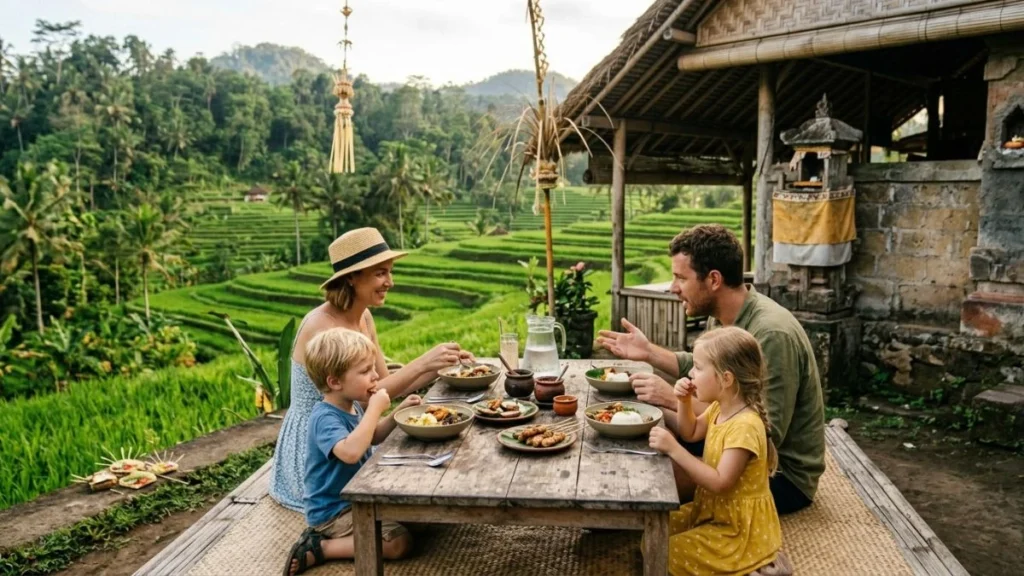
Bali is one of the more family-friendly destinations in Southeast Asia. The infrastructure for tourism is well developed, private hospitals are accessible from the main tourist areas, the food options for children are wide, and the Balinese cultural attitude toward children — genuinely warm, not performatively so — makes travelling with kids here a different experience from destinations where children are merely tolerated in adult spaces.
The honest picture on bali safety for families: the risks are real but specific and manageable. They are not the risks most parents worry about before the trip. Terrorism, crime, political instability — these are not the practical safety concerns for a family in Bali in 2026. Sun exposure, water safety, traffic, and mosquito-borne illness are. This guide addresses the actual risk profile rather than the theoretical one.
Quick Facts
- Overall safety level: Good — exercise normal precautions
- Main risks for families: Traffic accidents, sun exposure, dengue fever, water hygiene
- Medical care: Good private hospitals in Kuta/Denpasar; limited in rural areas
- Emergency number: 112 (national); Tourist Police: (0361) 224 111
- Travel insurance: Essential — include medical evacuation cover
- Best areas for families: Sanur, Seminyak, Nusa Dua, Ubud
The Actual Risk Profile for Families in Bali
Before getting into specifics, it’s worth being clear about what the risks in Bali actually are for families — because the gap between perceived risk and actual risk is wide.
What doesn’t warrant significant concern for families in Bali in 2026:
Violent crime against tourists is extremely rare. Terrorism has not affected Bali since 2005. Political instability is not a current factor. Child safety in the sense of abduction or targeted crime is not an elevated concern relative to most Western home countries.
What does warrant genuine attention:
Traffic accidents — the leading cause of serious injury to tourists in Bali, and the risk is higher for families who hire scooters with children. Dengue fever — a real and present risk, particularly in the wet season and in rice terrace areas. Water safety — tap water is not potable and food hygiene at the budget end of the market requires some care with young children. Sun exposure — the UV index in Bali runs extreme year-round and children burn faster than most parents expect.
Understanding which category each risk falls into changes how you prepare for the trip.
Traffic Safety: The Most Important Practical Concern
Every major government travel advisory for Bali flags road safety, and for good reason. Traffic accidents — predominantly involving scooters — are the most common cause of serious injury to tourists in Bali. For families, this risk is amplified by the temptation to hire a scooter and transport children on it.
Scooters and children: Hiring a scooter is legal and normal in Bali. Carrying children on a scooter is what most local families do. For tourists — unfamiliar with left-hand traffic, unaccustomed to the road conditions, often riding without an international driving permit — the risk calculation is different. A private driver for the day costs IDR 500,000–700,000, eliminates the traffic risk entirely, and split across a family of four is genuinely affordable. For families with young children, this is the straightforward recommendation.
If you do hire a scooter: Helmets for all riders including children — legally required, enforced inconsistently, non-negotiable for safety regardless of enforcement. Ride slowly. Avoid riding at night in unfamiliar areas. Do not ride after alcohol. Verify that your travel insurance covers scooter accidents — many standard policies don’t if you’re riding without a valid licence for that vehicle class.
Pedestrian safety: Pavements in Bali’s tourist areas are uneven, interrupted by drainage gaps, and not always present. In Ubud and the main streets of Seminyak and Canggu, traffic and pedestrians share space in ways that require active supervision of young children. Hold hands on main roads. Push strollers on the side away from traffic.
Water Safety: Beach, Pool and Drinking
Ocean Swimming
Bali’s beaches vary significantly in swimming safety and the distinction matters for families.
Safe for swimming with children:
Sanur — east-facing, calm, protected by a reef. The most consistently family-safe beach in Bali. Nusa Dua — similar conditions, calmer than the south-facing beaches, lifeguards present at the main resort beaches. Lovina (north coast) — calm, black sand, suitable for children.
Suitable with supervision and awareness:
Seminyak and Kuta — the surf is stronger than it looks, rip currents occur, and the beach is busy. Lifeguards are present at some sections. Children should stay in the shallower water close to shore and be supervised actively.
Not appropriate for young children:
Uluwatu, Padang Padang, Bingin, and the west-facing Bukit cliffs — powerful surf, rocky entry points, strong currents. These are experienced surfer beaches, not family swimming beaches. For the views and the culture they’re worth visiting; for swimming with children, they’re not appropriate.
Rip currents: Present on south and west-facing beaches. Teach older children the basics before the trip: swim parallel to shore if caught in a rip, don’t exhaust yourself swimming against it.
Pool Safety
Most villa and hotel accommodation in Bali has a private or shared pool. A significant proportion of villa pools have no fencing or safety barrier between the pool and the living area. This is a genuine concern for families with toddlers.
When booking accommodation with young children: ask specifically whether the pool has a fence or safety barrier. Many properties can arrange temporary fencing on request. Alternatively, choose ground-floor accommodation where the pool is visible from the living area rather than separated from it.
Pool drowning is a preventable risk that warrants specific planning when booking accommodation for families with children under 5.
Drinking Water
Tap water in Bali is not safe to drink. This applies equally to children. Bottled water (Aqua brand is the most reliable) is available everywhere and inexpensive. A filtered water bottle (LifeStraw or Sawyer) reduces plastic waste and works as a backup in areas where bottled water isn’t immediately available.
Ice in restaurants and cafés in tourist areas is generally made from filtered water and is safe. Ice at very budget warung in rural areas is less certain — use judgement.
Food Safety for Families
Bali’s food is generally safe. The tourist infrastructure in the main areas has adapted to international hygiene expectations over decades. A few practical calibrations for families with young children:
Warungs and local food: Safe for adults and older children with established immune systems. For toddlers and infants, slightly more selective choices are appropriate — look for busy warungs with high turnover, avoid anything sitting out that looks like it’s been there for hours, and stick to freshly cooked dishes.
Fruit: Fresh tropical fruit — mango, papaya, pineapple, salak, mangosteen — is one of Bali’s genuine pleasures and safe when peeled. Fruit that’s been pre-cut and left out is less reliable; buy whole fruit from markets and peel it yourself.
Spice levels: Balinese food can be significantly spicy. Order tidak pedas (not spicy) for children. Noodle soups (mie goreng, bakso), plain rice, and grilled chicken are reliable mild options available everywhere. Banana pancakes and fresh fruit are on almost every tourist café menu and work for even the pickiest children.
The stomach adjustment: Some children experience digestive upset in the first few days in Bali — new bacteria in a new food environment rather than food poisoning. Oral rehydration salts and a conservative eating approach for the first 48 hours smooth this transition. Bring oral rehydration salts from home.
Dengue Fever: The Health Risk That Warrants Genuine Attention
Dengue fever is the health concern in Bali that deserves the most specific preparation. Unlike Bali’s historical malaria risk (which is now very low in tourist areas), dengue is active year-round, carried by the Aedes aegypti mosquito that bites during daylight hours, and has no vaccine widely available to tourists in most countries.
Dengue in children tends to present more severely than in adults and requires medical attention sooner. Recognise the symptoms: high fever appearing 4–10 days after a mosquito bite, severe headache, pain behind the eyes, joint and muscle pain, rash. If a child develops a high fever in Bali or within two weeks of returning home, mention the Bali travel history to a doctor immediately.
Prevention is the only management strategy:
DEET-based repellent applied from early morning onward, appropriate concentration for children’s ages. Long sleeves and trousers in rice terrace areas and at dusk. Accommodation with air conditioning or mosquito nets. Eliminate standing water around your accommodation if you’re in a villa — even a small amount in a plant pot is a mosquito breeding site.
The detailed approach to mosquito protection is covered in the Bali packing list for families.
Medical Care: What’s Available and Where
Bali has good private hospital infrastructure in and around Denpasar and Kuta, accessible from most of the main tourist areas within 30–60 minutes depending on traffic.
Recommended private hospitals:
- BIMC Hospital Kuta — international standard, English-speaking staff, 24-hour emergency: (0361) 761 263
- BIMC Hospital Nusa Dua — similar standard, closer for south Bukit area: (0361) 3000 911
- Siloam Hospital Denpasar — well-equipped, 24-hour emergency: (0361) 779 900
- Prima Medika Hospital Denpasar: (0361) 228 788
What to know about medical costs: Private hospital care in Bali is not free and not cheap by Indonesian standards. A dengue diagnosis with IV rehydration can cost USD 500–1,500 for a few days. Medical evacuation to Singapore or Australia, if required for serious cases, costs tens of thousands of dollars. Travel insurance with medical coverage and emergency evacuation is not optional for families travelling with children.
Rural and remote areas: East Bali (Amed, Candidasa), North Bali (Lovina), and West Bali have limited hospital infrastructure. Minor issues can be handled at local clinics (puskesmas); serious cases require transfer to Denpasar. Factor the distance from medical care into your planning if you’re travelling with very young children or infants.
Child-Friendly Areas: Where to Base the Family
Sanur — consistently the top recommendation for families. Calm east-facing beach safe for children, flat and walkable town centre, good family restaurants, strong medical infrastructure nearby, proximity to Denpasar without being in it. Slightly quieter than Seminyak but that’s a feature, not a limitation, for families.
Nusa Dua — the most resort-oriented area in Bali, purpose-built for comfort and safety. Beach is calm and lifeguarded. Roads inside the resort complex are manageable for children. Less character than Sanur or Ubud but the most controlled environment for families who want predictability.
Seminyak — works well for families with older children. Beach requires supervision. Roads are busy. Good restaurant range and proximity to the airport. The evening scene is adult-oriented but families are present and accommodated during the day.
Ubud — excellent for families with children old enough to engage with culture, temples, rice terraces, and cooking classes. The Campuhan Ridge Walk is manageable for children from about age 6 upward. The Monkey Forest requires supervision and specific management (detailed below). No beach, but Sanur is 45 minutes east for a combined itinerary.
The Monkey Forest with Children
The Ubud Monkey Forest requires specific mention for families because the macaques here are genuine wild animals that interact with visitors in ways that can alarm or injure unprepared children.
The monkeys will investigate anything that appears to be food — bags, pockets, hands, and occasionally clothing. They are fast and persistent. A monkey grabbing at a child’s snack bag or climbing on a small child who is holding food is not aggressive behaviour — it’s food-seeking behaviour — but it’s frightening for young children and potentially scratchy.
Practical approach with children: No food in the forest, nothing that looks like food in accessible pockets or bags. Hold young children’s hands at all times near monkey concentrations. Don’t let children crouch to the monkeys’ level or try to touch them. Older children (7+) who understand and follow instructions enjoy the forest without issue. For toddlers and very young children, it’s worth thinking about whether the Monkey Forest is the right activity or whether the rice terraces or a cooking class is a better use of the day.
FAQ
Is Bali safe for young children?
Yes — with specific preparation for the actual risks. Sun exposure, mosquitoes, water hygiene, and traffic are the practical safety priorities. Violent crime against families is not an elevated concern. The main tourist areas have good infrastructure for families with young children.
What is the safest beach in Bali for families?
Sanur is consistently the safest and most family-appropriate beach in Bali — calm water protected by a reef, flat sandy entry, and lifeguards at main sections. Nusa Dua is the second recommendation. South and west-facing beaches (Kuta, Seminyak, Uluwatu) have stronger surf and require more active supervision.
Do I need travel insurance for Bali with kids?
Yes, without exception. Medical evacuation from Bali for a serious case can cost USD 50,000–100,000. Hospital care for dengue, scooter injuries, or other emergencies at private hospitals is not covered without insurance. Choose a policy that includes medical evacuation and covers children specifically — read the fine print on scooter coverage.
Is the food in Bali safe for children?
Generally yes in tourist areas. Cook-to-order dishes at busy warungs and restaurants are safe for older children. For toddlers and infants, slightly more careful choices are appropriate in the first few days while the digestive system adjusts. Bring oral rehydration salts from home and stick to freshly cooked, high-turnover food initially.
What vaccinations do children need for Bali?
Consult a travel medicine doctor or GP at least 6–8 weeks before departure. Standard recommendations typically include hepatitis A, typhoid, and ensuring routine childhood vaccinations are current. Some doctors recommend Japanese encephalitis for rural travel or extended stays. Rabies vaccination is worth discussing if your children are likely to interact with animals — dogs, monkeys, and bats in Bali carry rabies risk.
Bali with children is genuinely rewarding when the preparation matches the actual risk profile. The families who have difficult trips are usually the ones who underestimated sun and mosquitoes and overestimated the other things. The families who have great trips are usually the ones who planned the logistics — accommodation with safe pool access, a private driver rather than a scooter, sun protection and DEET applied from day one — and then relaxed into the rest of it.
The island is genuinely good with children. The Balinese affection for kids is real, the food culture is accommodating, and the combination of temples, rice terraces, beaches, and cooking classes produces itineraries that work across age groups. The bali safety for families picture in 2026 is a good one — specific preparation, general confidence.
For what to pack before you go, the Bali packing list for families covers the full kit. For entry requirements and current advisories, the Bali travel advisory 2026 has the current picture. For building the itinerary, the things to do in Ubud Bali guide and Ubud market guide are good starting points for the cultural interior.