
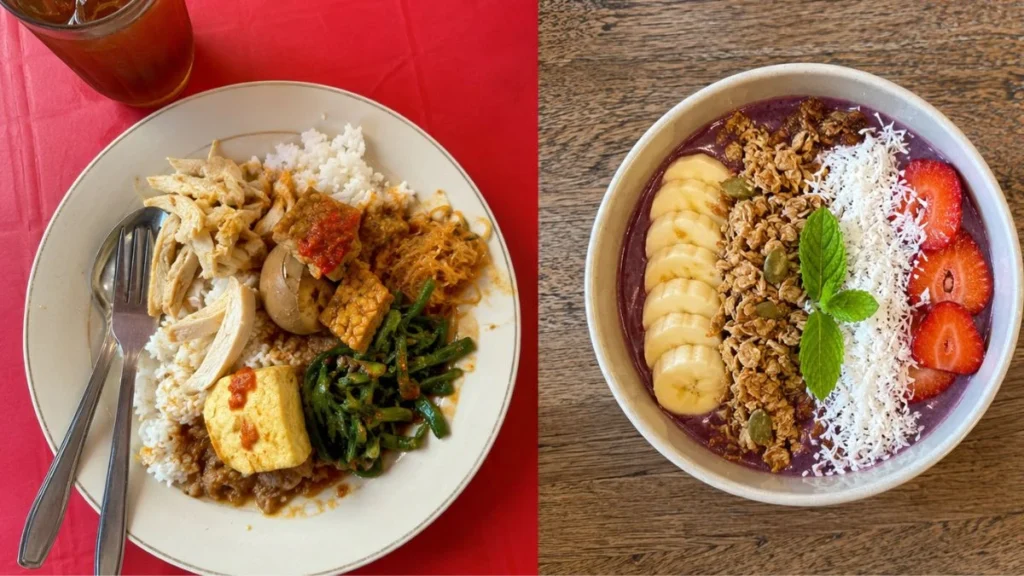
Cost of food in Bali: The cost of food in Bali in 2026 ranges from IDR 15,000 (USD 1) for a full warung meal to IDR 300,000+ (USD 19) for a beach club set menu. The gap between eating locally and eating at tourist-facing venues is larger in Bali than in most comparable destinations — which means where you choose to eat determines your daily food budget more than almost any other single decision.
The cost of food in Bali is one of the most searched budget questions about the island, and the honest answer has two parts that most guides conflate: Bali can be extraordinarily cheap for food, or it can be surprisingly expensive for Southeast Asia — depending entirely on which version of Bali you eat in. Local warungs remain very affordable, with meals often costing only a few dollars, while trendy cafés and beach clubs in areas like Canggu and Ubud can feel expensive compared to the rest of Southeast Asia.
This guide breaks the cost of food in Bali down by eating style — warung, local restaurant, tourist café, mid-range restaurant, beach club, and fine dining — with actual 2026 prices for each tier, the specific situations where each is worth it, and a daily food budget calculator for different traveller types.
The Fundamental Price Gap
Nasi goreng (fried rice) costs IDR 20,000–40,000 (USD 1.30–2.60), nasi campur (mixed rice plate) costs IDR 25,000–50,000, and a full meal with a drink rarely exceeds IDR 60,000 (USD 3.80) at a warung. The same food at a tourist café in Seminyak or Canggu costs 3–5x more.
That price gap — 3 to 5 times for essentially the same food — is the central fact of Bali food economics. It is not a quality gap. The warung nasi campur made with a stone-ground spice paste and cooked that morning is often better than the tourist restaurant version made with blended paste that costs four times as much. The gap reflects location, atmosphere, language of the menu, and who the establishment is calibrated for — not what is in the food.
Tier by Tier: What Food Actually Costs in Bali 2026
Warung (Family-Run Counter Eatery)
The cheapest and most genuinely Balinese eating experience available. A counter display of pre-cooked dishes, plastic chairs, cash only, and prices calibrated for local incomes.
Price range: IDR 15,000–35,000 per plate. Drinks: a refreshing iced tea or bottled water is around IDR 5,000.
A full nasi campur plate with drink costs IDR 25,000–50,000 (USD 1.60–3.20). Three warung meals per day costs IDR 75,000–150,000 (USD 5–10).
What you get: Rice, two to three protein or vegetable dishes, sambal, and a drink. Fresh, made that morning, genuinely representative of Balinese home cooking. No English menu. Cash only. The best version of Balinese food available outside a private family compound.
Where to find them: Back lanes of Ubud, Nyuh Kuning, Sanur behind the beachfront, Sidemen village, Amed, anywhere in East Bali.
Local Restaurant and Nasi Campur Specialist
A step above the basic warung — a dedicated space, some menu variety, but still primarily serving Indonesian and Balinese food at local prices.
Price range: IDR 35,000–80,000 (USD 2.30–5.20) per meal including drink.
Around USD 2–5 at local warungs and USD 8–12 at mid-range cafés. Street food is the cheapest.
The babi guling specialists (Warung Ibu Oka in Ubud, Warung Men Weti in Denpasar) sit in this tier — speciality dishes at IDR 50,000–80,000 that represent the ceiling of what a dedicated local food operation charges. Still significantly below tourist restaurant prices for equivalent quality.
Tourist-Facing Café (Ubud, Canggu, Seminyak)
This is where Bali’s food price perception becomes complicated. The café culture in Canggu and Ubud — smoothie bowls, avocado toast, matcha lattes, grain bowls — is priced at Western equivalents or above.
Modern cafés in places like Canggu, Seminyak, and Ubud can feel surprisingly Western in price. Eating out in Bali is generally cheaper than the US or Europe, but modern café culture has increased average food spending for many tourists.
Actual 2026 prices at tourist-facing cafés:
- Smoothie bowl: IDR 65,000–120,000 (USD 4–8)
- Avocado toast: IDR 75,000–130,000 (USD 5–8.50)
- Buddha bowl or grain bowl: IDR 80,000–150,000 (USD 5–10)
- Flat white coffee: IDR 45,000–65,000 (USD 3–4.25)
- Fresh juice: IDR 35,000–65,000 (USD 2.30–4.25)
A brunch at a tourist café in Canggu — smoothie bowl, coffee, juice — costs IDR 180,000–300,000 (USD 12–20) per person. Three such meals per day would cost USD 36–60 for food alone — higher than many budget accommodation options.
The honest position: tourist café food in Bali is not bad. The quality is generally good, the settings are often beautiful, and the occasional café brunch is one of the pleasures the island offers. But treating it as the primary eating mode produces a daily food spend that can match or exceed European prices.
Mid-Range Restaurant
Sit-down service, printed menu, some English-language orientation, mix of Balinese and international food.
Price range: IDR 70,000–180,000 (USD 4.60–12) per meal including drink.
A popular restaurant set menu costs IDR 70,000–120,000 for a complete meal.
This tier covers the Compound Warung category in Ubud — genuine quality at moderate prices — and most mid-range Indonesian restaurants throughout Bali. The food is a step down from the warung’s daily-fresh authenticity but significantly more polished and consistent than the tourist café tier.
Good for: evening meals, special occasions during a budget trip, venues where the setting adds to the experience.
Seafood on the Beach (Jimbaran Bay)
One of the most specifically Balinese dining experiences available — fresh grilled fish, squid, and prawns at tables on the sand at Jimbaran Bay with sunset views.
A standard package costs IDR 150,000–300,000 per person for a complete meal. For premium picks like lobster or king crab, prices start from IDR 400,000+ depending on weight.
The standard seafood set — grilled fish, rice, vegetables, sambal, coconut — at IDR 150,000–200,000 per person represents genuinely good value for the experience. Ordering à la carte or choosing premium items (lobster, king crab) pushes the cost significantly higher.
Beach Club and Fine Dining
The top of the Bali food price spectrum — beach clubs with minimum spends, tasting menus, and the full tourist-luxury infrastructure.
Beach club minimum spends: IDR 200,000–500,000 per person (often applied as food and drink credit).
Fine dining mains: IDR 200,000–600,000 (USD 13–39).
Tasting menus at top Ubud restaurants: IDR 800,000–2,000,000 (USD 52–130) per person.
Street food for USD 1 and fine dining for USD 100+. The range is that wide, and both ends genuinely exist.
Grocery Shopping: What Costs What
For travellers in villas with kitchens, buying at local markets and supermarkets:
Local morning market prices:
- Mangoes: IDR 20,000–35,000 per kg
- Bananas: IDR 10,000–20,000 per bunch
- Tomatoes: IDR 15,000–25,000 per kg
- Fresh tofu: IDR 5,000–10,000 per block
- Eggs: IDR 2,000–3,000 each
Supermarket (Pepito, Bintang, Carrefour) prices:
- Same mangoes: IDR 35,000–70,000 per kg
- Imported cheese (200g): IDR 80,000–150,000
- Imported wine (bottle): IDR 300,000–600,000
- Local Bintang beer (can): IDR 35,000–50,000
- Bread (local): IDR 20,000–40,000 per loaf
The market-to-supermarket price gap for locally grown produce is typically 40–80%. For imported goods — cheese, wine, foreign cereals, olive oil — supermarket prices are 1.5–3x Western equivalents due to import taxes.
Daily Food Budget by Traveller Type
Budget backpacker (warung only):
Breakfast: IDR 20,000–35,000 | Lunch: IDR 30,000–50,000 | Dinner: IDR 25,000–45,000 | Drinks: IDR 15,000–25,000
Daily total: IDR 90,000–155,000 (USD 6–10)
Mid-range traveller (mix of warung and cafés):
Breakfast at café: IDR 80,000–150,000 | Lunch at warung: IDR 35,000–55,000 | Dinner at restaurant: IDR 100,000–180,000 | Drinks and snacks: IDR 40,000–80,000
Daily total: IDR 255,000–465,000 (USD 17–30)
Café culture traveller (mostly tourist-facing venues):
Brunch at café: IDR 180,000–300,000 | Snack and coffee: IDR 80,000–130,000 | Dinner at restaurant: IDR 150,000–280,000 | Drinks: IDR 80,000–150,000
Daily total: IDR 490,000–860,000 (USD 32–56)
Luxury traveller (restaurants and beach clubs):
Daily total: IDR 1,000,000–3,000,000+ (USD 65–200+)
Where Location Changes Food Prices
Seminyak beachfront and Canggu’s tourist strip charge 40–60% more than identical food and accommodation a few kilometres inland.
The location premium is real and consistent. Eating in Ubud’s central streets costs more than eating in Ubud’s back lanes. Eating in Canggu costs more than eating in Sanur. Eating anywhere in south Bali costs more than eating in East Bali. The food is not better by an equivalent margin — the premium reflects proximity to tourist infrastructure rather than food quality.
East Bali (Sidemen, Amed, Candidasa) has the lowest food prices on the island outside of Denpasar’s local markets. A full nasi campur in Sidemen costs IDR 20,000–35,000. The same format in central Canggu costs IDR 80,000–180,000 at a tourist warung. The food at the Sidemen version is frequently better.
The Hidden Costs: What Adds Up Without Noticing
Daily coffee habit at tourist cafés: IDR 40,000–65,000 per flat white. Two coffees per day at a café = IDR 80,000–130,000 per day = IDR 560,000–910,000 per week.
Bottled water: If you are not using a refillable bottle with a filtered water station, bottled water costs IDR 5,000–15,000 per litre. Three litres per day in Bali’s heat = IDR 15,000–45,000 per day. A reusable bottle and refill station access eliminates this cost.
Alcohol: Local Bintang beer costs IDR 35,000–50,000 per can at a warung or minimart; IDR 50,000–80,000 at a restaurant; IDR 80,000–120,000 at a beach club. Imported spirits are significantly more expensive than local equivalents. Two beers per evening at a restaurant costs IDR 100,000–160,000 per day — more than a full warung meal.
Service charge: Mid-range and upscale restaurants add a 10% service charge plus 11% tax — 21% total above the menu price. Always check whether the menu price is inclusive or exclusive of this before ordering.
The Honest Summary
Eating is easily one of the highlights of visiting Bali, and your travel costs for food can be surprisingly low if you stick to local spots, or way more expensive than your home country.
The cost of food in Bali in 2026 is determined almost entirely by eating style rather than by Bali itself. A traveller who eats primarily at warungs spends USD 6–10 per day on food — genuinely one of the cheapest food budgets available anywhere in Asia. A traveller who eats primarily at tourist-facing cafés and restaurants spends USD 30–60 per day — comparable to mid-range European city dining.
Both are available on the same streets. Knowing the difference, and choosing intentionally, is the single most impactful budget decision on a Bali trip.
FAQ
How much does a meal cost in Bali in 2026?
At a genuine warung, a full nasi campur plate with drink costs IDR 25,000–50,000 (USD 1.60–3.20). At a mid-range local restaurant, a complete meal costs IDR 70,000–120,000 (USD 4.60–8). At a tourist-facing café in Canggu or Ubud, a brunch with coffee costs IDR 180,000–300,000 (USD 12–20) per person. The gap between eating locally and eating at tourist venues is 3–5x across comparable food types.
Is food expensive in Bali?
It depends entirely on where you eat. Warung food is among the cheapest available anywhere in Asia — USD 1.60–3.20 for a full meal. Tourist café food in Canggu and Ubud is comparable to mid-range European café prices. The choice of eating style determines whether food is a negligible or significant part of your daily Bali budget.
How much should I budget for food per day in Bali?
Budget travellers eating primarily at warungs: USD 6–10 per day. Mid-range travellers mixing warungs and cafés: USD 17–30 per day. Café culture travellers eating mostly at tourist venues: USD 32–56 per day. Luxury dining budget: USD 65–200+ per day.
Where is the cheapest food in Bali?
East Bali (Sidemen, Amed, Candidasa) consistently has the lowest food prices on the island — nasi campur for IDR 20,000–35,000 at village warungs. Denpasar’s local markets offer the cheapest grocery prices. In tourist areas, the back lanes of Ubud and Sanur have genuine warungs at significantly lower prices than the main tourist streets.
Does Bali have good vegetarian food?
Yes — Bali has extensive vegetarian and vegan food options across all price tiers. Warung nasi campur typically includes multiple vegetable dishes, tempeh, and tofu alongside meat options — you can construct a fully plant-based plate by selection. The tourist café sector in Canggu and Ubud has a particularly strong plant-based café culture. Specific vegetarian warungs like Siboghana in Ubud serve fully vegan Balinese cooking at genuine warung prices.