
Bali family holiday guide: Bali works well for families across a wide age range — the infrastructure for child-friendly travel is well-developed, the food is accommodating, the cultural experiences are genuinely engaging for older children, and the cost per day for a family of four is significantly lower than equivalent holidays in Europe or Australia. The main planning decisions — where to base yourself, how to structure daily transport, and which activities are worth the cost — are the ones that determine whether the trip is smooth or exhausting.
This bali family holiday guide covers the decisions that matter most before you arrive: which areas work for different family types, which activities are genuinely worth doing with children of different ages, what the transport situation requires in practice, and where the real costs are versus where Bali’s affordability delivers. It is written for parents who want to understand the trip before they book it, not after they arrive.
Bali is one of Asia’s top family destinations for good reason. Choosing the right base is the most important decision for a Bali family holiday. This guide makes that decision clear across the four main family-friendly areas and the specific activity landscape within each.
The Four Best Areas for Families in Bali
Sanur — The Best Base for Young Children
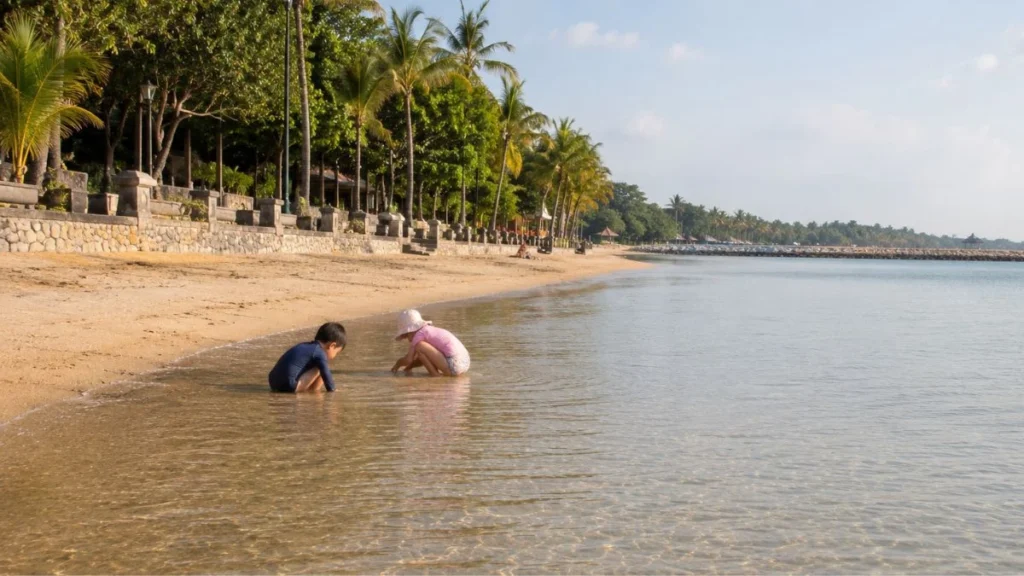
Sanur is one of the calmest areas in South Bali and a top pick for families with younger kids. The beach path is walkable, the water is usually calm, and it feels quieter and more laid-back.
The specific advantages for families with children under eight: the beach promenade runs for 4km and is wide enough for prams and small bikes. The water is protected by an offshore reef — no undertow, no surf, consistently swimmable for young children. The lanes behind the beachfront are residential and quiet. The morning market on Jalan Bypass opens before 7am and provides cheap fresh food and an early-morning activity for curious children.
Sanur also provides the most practical access to day trips: boats to Nusa Penida and Nusa Lembongan depart from the beach, the drive to Ubud takes 45 minutes, and the Bali Safari and Marine Park is 20 minutes east. For families who want a calm base with day-trip range, Sanur is the optimal choice.
Accommodation: Private villas with pools available from IDR 600,000–1,500,000 per night. Family rooms at mid-range hotels from IDR 400,000–800,000. The villa format works particularly well for families — private pool, kitchen, space for the children’s schedule to unfold without disrupting other guests.
Nusa Dua — For Maximum Organisation and Beach Safety
Nusa Dua is a gated, resort-heavy area known for clean beaches and well-managed infrastructure. Everything is organised, making it stress-free for parents.
Nusa Dua is Bali’s resort enclave — purpose-built for organised family tourism, with wide roads, manicured beach areas, and international hotel chains that have comprehensive children’s programming. It is not the most culturally immersive Bali experience, but for parents travelling with very young children or with school-age children who need structured activity options, the infrastructure is the best available on the island.
Mengiat Beach is perfect for toddlers, little kids, and older kids looking for safe sand and gentle waves. The beach is cleaned daily, the water is consistently calm, and the resort strip provides shade, food, and facilities at close range.
The trade-off: Nusa Dua is expensive relative to other Bali areas, and the resort-enclave character makes it feel less like Bali and more like a well-run tropical resort complex. For families who want the authentic Bali character alongside the family infrastructure, Sanur or Ubud serves better.
Ubud — For Families with Older Children and Cultural Interest
Ubud sits in the heart of Bali and is surrounded by rice terraces, jungles, and cultural experiences. It’s quieter than beach areas and ideal for families who want meaningful, less commercial experiences.
Ubud works best for families with children aged eight and above who can engage with cultural sites, walking trails, and hands-on experiences. The cultural infrastructure — cooking classes, batik workshops, temple visits, the Sacred Monkey Forest — produces the kind of engaged experience that makes children remember a trip rather than simply having been somewhere warm.
Bali Family Hangout in Canggu, Bali is a covered, eco-conscious indoor playground designed for children ages two to seven, featuring wooden climbing structures, slides, and shaded play areas surrounded by tropical greenery. A similar facility operates near Ubud — worth knowing for the inevitable rainy afternoon.
The practical challenge with Ubud for families: there is no beach. The nearest swimming beach is 45 minutes by car. Families who want both cultural experience and beach access typically split a Bali trip — three to four nights in Ubud, the remainder in Sanur or Nusa Dua.
Canggu — For Families with Teenagers
Canggu’s surf culture, café scene, and social energy make it the most engaging area for teenagers who want some independence and their own activities. Beginner surf lessons are available at multiple points along the Canggu coast for IDR 200,000–350,000 per session including board and instructor — a structured activity that teenagers engage with willingly.
For families with younger children, Canggu is less suitable: the beach is grey volcanic sand with surf conditions that are not appropriate for swimming with small children, the roads are busy, and the social infrastructure is oriented toward adults and older teens rather than young families.
Activities Worth the Cost for Families
Bali Safari and Marine Park — Full Day, Worth the Price
Bali Safari and Marine Park combines adventure with safety. You can take a safari bus ride past zebras, rhinos, and lions, enjoy interactive shows, or let little ones explore the petting zoo. The water play zone is great for cooling off in the tropical heat, and shaded areas make it easy for parents to relax.
This is the single most consistently recommended activity for families with children across ages four to fourteen. The safari bus circuit, the animal shows, and the water play zone together fill a full day without the children becoming bored or over-stimulated. Arrive early for the first safari ride and avoid the midday heat for outdoor sections.
Entry costs approximately IDR 600,000–900,000 per adult and IDR 450,000–650,000 per child. Book in advance — it fills during school holidays.
Sacred Monkey Forest Sanctuary, Ubud — Excellent for Ages Six and Up
The Sacred Monkey Forest in central Ubud is a genuine forest temple complex housing over 1,000 long-tailed macaques. Children who are old enough to understand the interaction guidelines — do not hold food visibly, do not make sudden movements, follow the guides’ instructions — find it genuinely memorable. Younger children who cannot follow these guidelines are better kept to the perimeter.
Entry: IDR 80,000 adults, IDR 60,000 children. Guides available at the entrance for IDR 100,000–150,000 and are worth hiring for the animal interaction context they provide.
Waterbom Bali, Kuta — For Heat Relief and Pure Fun
Waterbom Bali offers shaded splash zones, gentle slides, and safe areas for younger children. It is Bali’s most comprehensive water park and is designed for the full family age range — the toddler zones are genuinely separated from the high-speed slides, which means parents of younger children are not stressed by proximity to inappropriate equipment.
Entry: IDR 400,000–600,000 per person. Located in Kuta — 30 minutes from Sanur, 45 minutes from Ubud.
Turtle Release Programmes — Best for Ages Five and Up
Several conservation programmes along Bali’s south and east coast allow families to participate in turtle egg monitoring and hatchling release. The activity is educational and emotionally engaging — children who release baby turtles into the ocean consistently describe it as a trip highlight regardless of age. Programmes are available through conservation organisations in Kuta and Candidasa.
Costs vary by operator: IDR 100,000–300,000 per family. Always choose a programme with documented conservation credentials rather than commercial turtle operations.
Cooking Class — For Ages Eight and Up
A family Balinese cooking class — particularly one held in a family compound rather than a hotel kitchen — combines the cultural experience of the Balinese cooking class Ubud guide with an activity that children of eight and above can genuinely participate in. Making satay, learning to use a stone grinder, and eating what you cooked together in a family compound produces the kind of shared experience that travel exists to create.
Transport: The Practical Reality for Families
Bali’s transport options for families narrow significantly compared to solo or couple travel. The honest assessment:
Private driver for all family movement. This is not a luxury for families — it is a practical necessity. Car seats are not available in Grab or Gojek vehicles. Scooters are not appropriate for young children. A private car with driver for a full day costs IDR 400,000–700,000 — for a family of four, this is IDR 100,000–175,000 per person, cheaper than four individual Grab rides across a full day of movement.
Establish a relationship with one driver for the duration of your stay. The consistency reduces the daily logistics overhead significantly. Your accommodation can recommend a trusted driver; this is the most reliable source for family travel.
Pram and buggy: Ubud’s main streets have significant foot traffic and uneven pavement — a lightweight foldable buggy handles it better than a full-size pram. Sanur’s beach promenade is pram-friendly throughout its length. Nusa Dua’s resort areas are fully pram-accessible.
Food: What Actually Works for Children in Bali
Balinese food is generally well-tolerated by children — the rice-based format is familiar, the mild versions of dishes (reduced chilli, less shrimp paste) are available at virtually every warung and restaurant, and the specific dishes that children consistently enjoy include nasi goreng (fried rice), mie goreng (fried noodles), satay, and fruit plates.
Food is where Bali stays good value. Local meals are cheap, and even eating at western-style restaurants is still reasonable compared to many family holiday destinations.
Tap water in Bali is not potable. All children’s drinks should be bottled or filtered. Ice at restaurants in tourist areas is generally made from filtered water, but in remote or local areas, avoiding ice is the conservative choice. Stomach illness is the most common health issue for visiting children — mild, usually short-lived, but worth carrying basic rehydration sachets for.
Budget: What a Bali Family Holiday Actually Costs
For a family of four (two adults, two children) over ten nights:
| Category | Budget option | Mid-range | Comfortable |
|---|---|---|---|
| Accommodation (per night) | IDR 600k–1M villa | IDR 1M–2M villa | IDR 2M–4M villa |
| Food (per day) | IDR 200k–350k | IDR 400k–700k | IDR 700k–1.5M |
| Transport (per day) | IDR 400k–500k driver | IDR 500k–700k driver | IDR 700k–1M driver + extras |
| Activities (per day) | IDR 200k–400k | IDR 500k–900k | IDR 1M–2M |
| Total per day | IDR 1.4M–2.25M | IDR 2.4M–4.3M | IDR 4.4M–8.5M |
At the mid-range level, a family of four can spend ten nights in Bali for approximately USD 1,500–2,800 in total — significantly less than equivalent family holidays in Europe, Australia’s resort areas, or Southeast Asian destinations with similar infrastructure.
Activities add up quickly if you try to do everything. Picking a few highlights and leaving space for rest days usually saves money and sanity.
The Best Time for a Bali Family Holiday
The dry season from April to October provides ideal conditions for family travel with temperatures between 27–30°C and minimal rain. While July and August draw the largest crowds, many families find May, June, and September offer an excellent mix of good weather and manageable tourist numbers.
For families with school-age children constrained to school holiday periods: July and August are unavoidable and are the most crowded and expensive months of the year. Book accommodation at least three to four months in advance for July–August family villa stays in Sanur, Ubud, and Nusa Dua.
For families with flexible timing: May and September offer the best combination of dry season weather, manageable crowds, and accommodation availability.
Practical Family Travel Tips for Bali
Malaria and dengue: Bali is officially malaria-free. Dengue fever risk is present — mosquito repellent containing DEET is the standard prevention, particularly for children. Apply in the evenings and in jungle or garden areas.
Sun: Tropical UV is significantly stronger than temperate zone UV. SPF 50+ for children is the baseline. Hats, rash vests for beach days, and midday shade are standard family practices.
Medical facilities: Sanglah Hospital in Denpasar and BIMC Hospital in Kuta and Nusa Dua provide international-standard medical care. BIMC has English-speaking staff and is the most visitor-oriented facility. Travel insurance that covers medical and emergency evacuation for children is essential.
Time zone adjustment: Bali is UTC+8. For families travelling from Australia’s east coast, the time difference is 1–2 hours — minimal adjustment. From the UK or Europe, the 7–8 hour difference affects children more significantly. Plan the first 1–2 days with light activities and flexible mealtimes.
FAQ
Is Bali good for families with young children?
Yes — Bali is one of Southeast Asia’s most family-friendly destinations. The food is accommodating, the beach options (particularly Sanur and Nusa Dua) have calm swimmable water, the villa format provides space and private pools suited to young children’s schedules, and the cost per day for a family of four is significantly lower than equivalent holidays in Europe or Australia.
What is the best area in Bali for families?
Sanur for families with children under eight — calm beach, walkable promenade, quiet neighbourhood, and good day-trip access. Nusa Dua for maximum organisation and beach safety in a resort setting. Ubud for families with children aged eight and above who can engage with cultural experiences. Canggu for families with teenagers who want surf lessons and independence.
What age is Bali suitable for?
Bali works across all ages, but the activity landscape changes significantly by age group. For babies and toddlers: beach days, pool time, and relaxed exploration. For ages four to seven: Bali Safari and Marine Park, Waterbom, Sacred Monkey Forest (supervised). For ages eight to twelve: cooking classes, cultural sites, snorkeling, river rafting. For teenagers: surf lessons, cooking, cultural immersion, nightlife-adjacent areas like Canggu.
How much does a family holiday in Bali cost?
A family of four (two adults, two children) at mid-range — private villa with pool, daily driver, mix of local and restaurant meals, two to three paid activities per week — costs approximately IDR 2.4M–4.3M per day, or USD 150–270. Over ten nights, the total runs approximately USD 1,500–2,700 — significantly less than equivalent family holidays in Europe or Australia.
What is the best time for a family holiday in Bali?
May, June, and September offer the best combination of dry season weather and manageable crowds for families with flexible timing. July and August are peak season — best weather but highest crowds and prices; book three to four months in advance. The wet season (November to April) is cheaper but brings afternoon rain that disrupts outdoor activities.