
Sustainable travel Bali tips: Bali received over 6 million international visitors in 2025. The island is actively managing the tension between tourism income and the environmental and cultural degradation that volume produces. As a visitor in 2026, your specific choices — where you stay, what you eat, how you move, who you pay — determine which side of that equation you land on.
These sustainable travel Bali tips are not a list of virtuous gestures. They are a practical guide to making choices that produce genuine impact — because the gap between “sustainable travel” as a marketing category and sustainable travel as a set of specific decisions with specific consequences is wide, and most guides do not close it.
The context in 2026: Bali’s provincial government has formally committed to a quality-over-quantity tourism strategy, introduced stricter visitor conduct regulations under Governor’s Circular SE No. 7/2025, and is actively deporting visitors who violate cultural and environmental norms. The direction of travel is clear — Bali is moving toward a model that asks more of visitors and enforces those asks more consistently. This guide covers what that means practically for how you plan and conduct your trip.
For the specific accommodation choices that align with genuine sustainability practice, the eco stays Bali honest guide covers how to distinguish real from greenwashed across every budget level.
The Honest Starting Point: What Tourism Costs Bali
Understanding what mass tourism costs the island makes the sustainable choices feel like the correct response to a real situation rather than a lifestyle preference.
Water: South Bali’s groundwater is under documented stress from tourism infrastructure — hotel pools, landscaping, villa operations, and laundry services pump groundwater at rates that exceed natural recharge in coastal areas. The aquifer depletion affects local farmers and households whose wells are affected by the same drawdown.
Waste: Bali generates approximately 4,000 tonnes of waste daily. The infrastructure for processing that waste has not kept pace with the volume. Plastic waste in particular flows from tourist areas into rivers and coastal waters — the ban on single-use plastics introduced in 2019 and reinforced in 2025 exists because the problem is structural, not incidental.
Agricultural land: Rice paddies and working farmland are being converted to villa developments, restaurants, and commercial properties at a rate that directly reduces the subak irrigation system’s functional area and the visual and agricultural landscape that tourism itself depends on.
Cultural integrity: The ceremonies, temples, and daily spiritual practices that draw visitors to Bali are maintained by a community that is also hosting 6+ million visitors a year. The demand that those practices remain accessible to visitors while the visitors’ behaviour progressively intrudes on the conditions required to maintain them is a genuine tension.
None of this makes tourism to Bali wrong. It makes specific choices within tourism meaningful.
Where You Stay: The Highest-Impact Decision
Accommodation accounts for the largest single share of tourism’s environmental and economic footprint. The choices that produce the most impact:
Stay in locally owned properties. A villa operated by an Indonesian family keeps the revenue in the local economy. A property owned by foreign investors and managed by international staff exports the financial benefit. This distinction is not always visible from listing platforms but can usually be determined by asking directly who owns the property.
Avoid groundwater-intensive operations. Properties with large pools in south Bali’s coastal zone are contributing to the aquifer depletion documented above. Properties in highland areas (Ubud, Sidemen, Munduk), with rainwater collection systems, or with smaller water footprints are structurally better choices. This is worth asking about directly before booking.
Choose properties with verifiable sustainability practice. The eco stays Bali honest guide covers how to assess this before booking. The marker of genuine practice: specific answers to specific questions, not general language about caring for the environment.
Stay longer in fewer places. The carbon footprint of getting to Bali is fixed regardless of trip length. A two-week stay at three bases has a lower impact per day than a ten-day stay at six bases with daily transport between them. Slow travel is sustainable travel in a literal sense — fewer transfers, lower per-day emissions, deeper local economic integration.
What You Eat: Direct Community Investment
Food spending is the most direct daily transfer of income between visitor and local community.
Eat at genuine warungs. IDR 30,000–50,000 at a family-run warung goes directly to the household that cooked the food. The same amount at a tourist-facing café goes partially to a rent payment on a lease held by a property investor and partially to a supply chain that may not involve local producers. This is not a minor difference in aggregate.
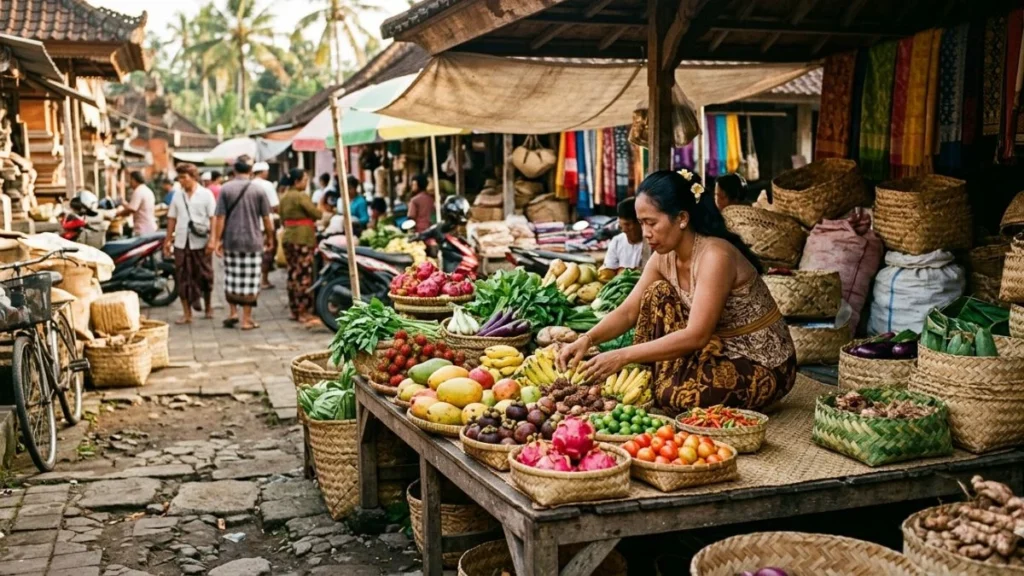
Buy from morning markets. Ubud, Gianyar, Klungkung, and Amlapura markets sell locally grown produce at prices that reflect local incomes rather than tourist-facing markups. Spending IDR 50,000 at a morning market funds local farmers and market traders directly. Spending the equivalent at a supermarket or organic café funds supply chains of varying local integration.
Choose Balinese food over imported cuisine. This is not a rule — eating a bowl of pasta occasionally is not a sustainability failure. The principle: every meal of locally grown, locally cooked Balinese food has a lower transport footprint, a higher local economic impact, and no import cost than the same meal assembled from imported ingredients.
How You Move: The Transport Choices That Matter
Scooter over private driver for short distances. A private car with driver for a 5km trip to the nearest temple is not efficient transport — it is convenience transport. A scooter covers the same distance at a fraction of the fuel and carbon cost. For visitors comfortable on a scooter, using one for daily movement and reserving private drivers for longer circuits is the lower-impact approach.
Group transport where practical. Sharing a private driver between two to four people halves or quarters the per-person carbon and cost. The same driver trip that costs IDR 500,000 solo costs IDR 125,000–250,000 per person shared.
Public transport where functional. Trans Metro Dewata’s IDR 4,400 flat fare covers the Denpasar–Ubud corridor adequately. The system is expanding. Using it where it works reduces individual transport impact and contributes to the viability of a public transport network that Bali’s long-term development genuinely needs.
Fly less, stay longer. If you are flying to Bali from Australia, the UK, or North America, the carbon cost of the flight is the largest single item in your trip’s footprint. Staying longer amortises that fixed cost over more days. This is the single highest-impact sustainable travel choice available to any visitor regardless of what they do once they arrive.
How You Behave: The Regulatory and Cultural Framework
Bali’s 2025–2026 regulatory framework is explicit: visitors who violate cultural norms or environmental regulations face deportation. This is not a threat — it is an active enforcement policy. The what not to do in Bali guide covers the full regulatory picture. The sustainable travel dimension is this: respecting the cultural and environmental rules is not optional compliance with an external authority — it is part of the minimum threshold for visiting responsibly.
No single-use plastics. The ban is law. Bring a reusable bag, water bottle, and coffee cup. This is not a significant inconvenience. It is a direct reduction in the waste stream that flows into Bali’s rivers and coastal waters.
Dress appropriately at sacred sites. The sarong is not a cultural performance — it is the condition under which the sacred sites remain accessible to visitors. Resisting it is not individualism; it is the slow accumulation of behaviour that produces restricted access for everyone.
Follow the temple spatial rules. The inner sanctuaries are not restricted to create an air of exclusivity. They are restricted because active worship is happening and the conditions required for that worship require the space to be maintained. Entering uninvited degrades those conditions.
Do not photograph ceremonies at close range. The odalan is not a performance. The ngaben is not an attraction. Treating them as such — physically intruding on the space with a camera — erodes the willingness of communities to permit visitor presence at future ceremonies. The access that slow travellers value is maintained only by the behaviour of the visitors who came before them.
Where You Spend: The Economic Multiplier
Every tourism rupiah spent in Bali does not have equal impact. The economic multiplier — the degree to which spending circulates within the local economy rather than leaking out — is highest for:
Local accommodation operators. A family guesthouse recirculates a higher percentage of revenue within the local economy than an international hotel chain.
Local food businesses. Warungs and local restaurants have higher local supply chain integration than tourist-facing cafés sourcing international ingredients.
Local guides and artisans. Hiring a Balinese guide directly rather than through an international booking platform means more of the fee stays local. Buying craft directly from the maker at a village workshop rather than from a tourist market that marks up the same items by 200% keeps money in the producing household.
Local transport operators. Negotiating directly with a Balinese driver rather than booking through an international platform keeps the commission local.
None of this requires sacrifice — the locally sourced versions of each of these are typically more affordable and more interesting than the tourist-facing equivalents.
The Practical List
Before you leave:
- No single-use plastics: pack a reusable bag, water bottle, and coffee cup
- Research your accommodation’s actual sustainability practice before booking
- Check the Galungan, Nyepi, and major festival calendar and plan your arrival to experience rather than avoid
While there:
- Eat at genuine warungs at least half the time
- Buy from morning markets where available
- Use Grab/Gojek or scooter rather than solo private car for short distances
- Spend at locally owned shops, guides, and services rather than international platforms
- Follow the temple dress code every time, not just at major tourist temples
- No single-use plastic — decline plastic bags at every transaction
Cultural conduct:
- Read the what not to do in Bali guide before arrival
- At ceremonies: observe from the perimeter, camera down, sarong on
- If a local explains something to you, listen — the knowledge is not available from a guidebook
Kwame had spent a week in Canggu in 2023 and had barely interacted with a Balinese person. His second trip, two years later, was structurally different: a family guesthouse in Penestanan, morning market visits, a Sidemen guesthouse for five nights, a guided trek where he spent the morning learning about the subak system from a farmer whose family had worked the same paddies for four generations. He said the first trip had cost him more money and produced a less interesting experience. The second trip had been cheaper in total and had given him a Bali that the first one had not made available. The difference was not willingness — it was knowing which choices opened which doors.
FAQ
What are the most impactful sustainable travel choices in Bali?
In order of impact: stay longer in fewer places (reduces flight carbon per day and increases local economic integration), stay in locally owned accommodation (keeps revenue in the local economy), eat at genuine warungs (direct community income transfer), and follow the no single-use plastic rules consistently (direct reduction of Bali’s documented waste problem). These four choices together produce more genuine impact than any number of “eco-friendly” product purchases.
Is Bali environmentally friendly to visit?
Bali faces real environmental pressure from tourism — water scarcity in south Bali, plastic waste in rivers and coastal areas, agricultural land conversion, and cultural site overcrowding. The island is not pristine and should not be visited as if it were. It is a destination where visitor choices produce meaningful consequences and where the provincial government is actively trying to shift the tourism model toward lower-impact, higher-value visits. Visiting responsibly means understanding the actual situation rather than the aspirational version.
What is the single-use plastic rule in Bali?
Single-use plastics — bags, Styrofoam containers, straws, and plastic-packaged drinks — are banned in Bali under the 2019 Provincial Regulation, reinforced by Governor’s Circular SE No. 7/2025. This is enforceable law, not a request. Bring a reusable bag and water bottle from home. Most Bali-based shops and warungs are already operating plastic-free by default; the infrastructure for reusable alternatives (refill stations, reusable bag availability) is well-developed.
How can I support local communities in Bali as a tourist?
Eat at family-run warungs rather than tourist cafés. Buy from morning markets and directly from artisan workshops rather than tourist markets that mark up the same items. Hire local guides directly rather than through international booking platforms. Stay in locally owned guesthouses and villas rather than internationally managed properties. These choices direct more of your spending to Balinese households rather than to foreign investors and international service chains.
What is Bali doing about sustainable tourism in 2026?
Bali’s provincial government has committed to a quality-over-quantity tourism strategy in 2026, targeting 6.6 million visitors with a focus on responsible behaviour, cultural respect, and environmental compliance. Stricter visitor screening, enforcement of the 2025 conduct regulations (including deportation for serious violations), expansion of the single-use plastic ban, and investment in waste management and green energy infrastructure are the primary active measures. The tourist levy (IDR 150,000) contributes directly to cultural preservation and environmental protection at the village level.