
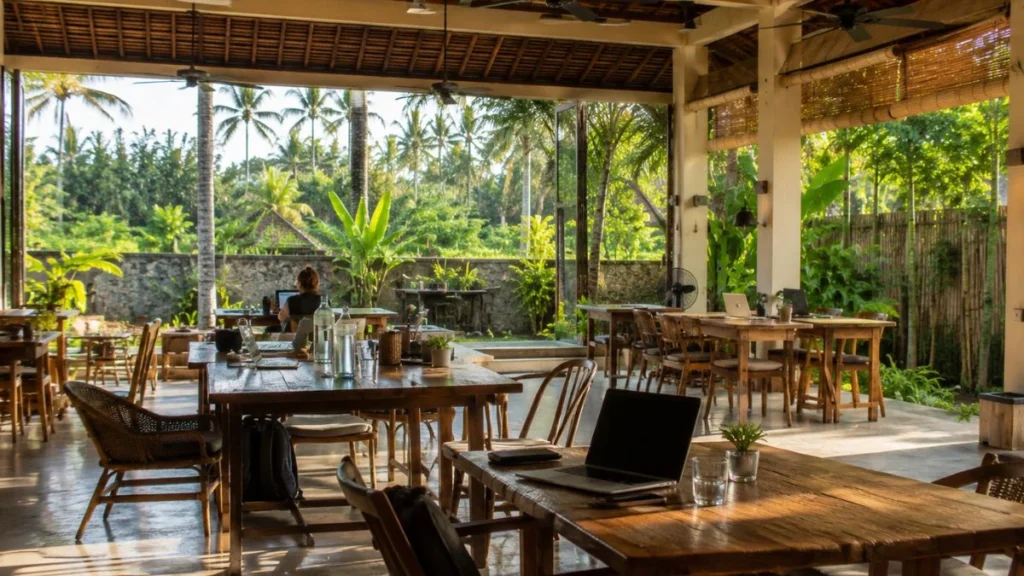
Bali digital nomad accommodation Canggu: Canggu is the easiest soft landing for a first-time digital nomad in Bali — the coworking infrastructure, social scene, and fast internet are already built. The honest question is not whether Canggu works, but whether it is the right base for how you actually work, and whether the premium it charges over other Bali areas is worth it for your specific situation.
This guide to bali digital nomad accommodation Canggu covers the accommodation options honestly — co-living, private villa, café-based working, and the specific coworking spaces that deliver on the internet speeds they claim — alongside the one question that most Canggu guides avoid asking: should you actually be based in Canggu at all, or does a different area of Bali serve your working style better at a significantly lower cost?
Canggu works. It is one of the most functional digital nomad infrastructure environments in Southeast Asia. It also has real trade-offs that become apparent within a week of arrival and significant within a month. This guide presents both sides without selling either.
For the full picture of what living in Bali costs beyond accommodation, the cost of living Bali 2025 expat breakdown covers monthly budgets across food, transport, visa, and utilities. For the rental negotiation mechanics that apply across all Bali areas, the long stay Bali monthly rental tips covers the process in detail.
What Canggu Actually Offers in 2026
Canggu in 2026 is a coastal strip running from Pererenan in the north through Batu Bolong to Echo Beach and Berawa in the south — approximately 10km of beach road with satellite neighbourhoods spreading inland through rice fields and villa developments. It is not one place. It is a collection of micro-areas with distinct characters:
Batu Bolong — the highest density of cafés, restaurants, surf breaks, and social infrastructure. The most expensive accommodation. The most traffic. The easiest place to meet people without trying.
Berawa — slightly calmer, more residential feel. The Finns Beach Club corridor. Preferred by couples and professionals who want Canggu’s infrastructure without its most chaotic stretch.
Pererenan / Cemagi — the quietest western edge. Rice paddies still exist between villa developments. Lower accommodation prices. Requires a scooter for everything. Growing in popularity among nomads who have already done the Batu Bolong chapter.
Echo Beach area — surf-focused. Older, more worn-in than Batu Bolong. The beach itself is grey volcanic sand. The warung culture near the beach is more authentic than the main Canggu strip.
Internet: What the Actual Speeds Are
Canggu has some of the fastest and most reliable internet in Bali. Independent speed tests at cafés and coworking spaces in 2025–2026 consistently show 60–85 Mbps download and 40–80 Mbps upload at the better establishments. Top coworking spaces like Dojo, Outpost, and Tropical Nomad deliver 75–100 Mbps reliably.
The important caveats: café internet degrades significantly during peak hours (10am–2pm when every table is occupied). Villa internet varies enormously — some properties have fiber connections delivering 50–100 Mbps; others have shared connections that slow to unusable speeds during the evening. Test villa internet at different times of day before committing.
A Telkomsel or XL local SIM with an unlimited data package costs IDR 100,000–200,000 per month and serves as a reliable backup. For video calls and mission-critical work, having mobile data as a backup to villa or café Wi-Fi is the standard nomad practice in Canggu.
Accommodation Options: What Each One Actually Delivers
Co-living Spaces
Co-living is the most practical option for first-time Canggu arrivals — the infrastructure removes the decisions required for a private villa (internet, utilities, cleaning, social connection) and puts them into a single monthly rate.
Outpost Canggu — the most established co-living operation in the area. Private rooms with AC and en-suite bathroom, coworking space included in the rate, social events, and a community of nomads who are typically more serious about their work than the average Canggu café crowd. Monthly rates from approximately IDR 15–20 million including coworking access. Limited private villa rooms are available at higher rates.
Tropical Nomad — coworking space on Jl. Subak Canggu that also offers co-living. Consistent internet speeds (claimed and actual 100 Mbps), indoor palms, good coffee, and a working atmosphere that is quieter than the café format. Monthly coworking membership from IDR 1.5–2 million. Co-living rooms from approximately IDR 10–14 million per month.
Dojo Bali — the largest coworking operation in Canggu, with multiple spaces across the area. Day passes, weekly and monthly memberships. Does not offer co-living directly but has relationships with nearby accommodation providers. Monthly hot desk from IDR 1.8 million. The community programming — networking events, workshops, founder meetups — is the strongest of any coworking space in Canggu.
Shashvata — newer co-living operation in Pererenan, quieter than Batu Bolong options, strong on wellness programming (yoga, meditation) alongside coworking infrastructure. Better choice for nomads who want Canggu access without Batu Bolong noise density.
Private Villas
The private villa is the preferred format for nomads staying two months or longer and valuing space and privacy over co-living community. Current 2026 market rates for private villas in Canggu through direct negotiation:
| Type | Monthly rate (direct) |
|---|---|
| Studio / 1-bed room | IDR 7–12 million |
| 1-bed villa (no pool) | IDR 10–15 million |
| 1-bed villa (with pool) | IDR 13–20 million |
| 2-bed villa (with pool) | IDR 18–30 million |
Platform rates on Airbnb and Booking.com are typically 25–40% higher than these direct negotiated rates. The gap is largest for longer stays — a villa priced at IDR 20 million per month on Airbnb may negotiate to IDR 14 million on a three-month direct commitment.
The most important variable for working from a private villa in Canggu: internet quality and noise level. Request an actual speed test result before viewing the property. Spend time at the property during both morning working hours and evening social hours — Canggu’s noise profile from nightlife, construction, roosters, and road traffic is specific and worth assessing personally before you commit.
Café-Based Working
For nomads who prefer working from different environments each day rather than a fixed space, Canggu’s café density is its most distinctive asset. The working café culture here is more developed than anywhere else in Bali — most cafés actively accommodate laptops, power access is standard, and the etiquette around working from cafés is well-established.
Internet speeds tested at Canggu cafés in 2026:
SatuSatu — consistently cited as one of the fastest café connections in Canggu. 70–85 Mbps. Focused working atmosphere. Rice field setting.
Two Faces — 65–80 Mbps. Good coffee. Seats fill quickly by 10am.
Miel — speciality coffee, 60–75 Mbps, quieter than the main strip.
Revolver — smaller, higher coffee quality, internet variable depending on traffic. Better for two-hour sessions than full-day working.
The practical limitation of café-based working in Canggu: the best spots are full by 9–10am on weekdays. Arriving before 8:30am is the standard strategy. Afternoon working sessions (2–5pm) are generally easier for seat availability.
The Honest Trade-Off Assessment
Canggu is the right base if you are new to Bali and need the community infrastructure already assembled, if your work benefits from social stimulation and regular connection with other professionals, or if surf access in the morning is a non-negotiable.
Canggu is not the right base if your work requires extended focus without social interruption, if you are budget-sensitive and the Canggu premium does not reflect a genuine value difference for your situation, or if you have been in Bali before and already have the orientation that Canggu’s community provides to first-arrivals.
The specific areas to consider instead:
Ubud outskirts (Penestanan, Sayan) — lower accommodation costs, cooler climate, quieter working environment, better for writers and deep-focus work. Internet is sufficient (50 Mbps at good coworking spaces including Outpost Ubud and Hubud) though below Canggu’s ceiling. Less social infrastructure.
Sanur — the most underrated digital nomad base in Bali. Calmer than Canggu, good café culture, stable internet in most areas, significantly lower accommodation costs. Less social energy than Canggu — which is either a feature or a limitation depending on how you work.
Pererenan (within Canggu) — the best compromise if you want Canggu infrastructure without Batu Bolong density. Quieter, slightly lower rents, still within scooter range of all the main coworking spaces and cafés.
Dani had been in Canggu for six weeks when she moved to Sanur for a month to compare. In Canggu she had spent IDR 15 million per month on a one-bedroom villa and had found the social scene genuinely valuable for the first three weeks. By week five, she described Canggu as an attention environment — always something happening, always a reason to not be working. In Sanur she paid IDR 9 million for a comparable villa, worked three more hours per day on average, and found the one coworking space on the waterfront perfectly adequate for her video call and writing schedule. She went back to Canggu for her final month because she missed the community. She said both versions of the choice were correct and that knowing the difference between them was only possible after having experienced both.
Practical Setup Checklist for Canggu
Before committing to any accommodation:
Internet speed test — request a live Speedtest.net result, not a screenshot. Test at different times of day if possible.
Noise assessment — visit the property in the evening. Canggu’s nightlife and rooster density are best assessed in person.
Distance to coworking — if your villa has unreliable internet, confirm you have a coworking backup within a 10-minute scooter ride.
Air conditioning — test all units. Canggu coastal humidity makes AC essential for sleeping and for sustained working focus.
Pool maintenance — confirm responsibility and frequency in writing.
Scooter parking — essential in Canggu. Covered parking is worth paying a slight premium for.
Local SIM card — get Telkomsel or XL on arrival. IDR 100,000–200,000 per month for unlimited data. Essential backup to any villa or café internet.
FAQ
Is Canggu good for digital nomads in 2026?
Yes — Canggu has one of the most developed digital nomad ecosystems in Southeast Asia, with fast internet (60–85 Mbps at good cafés and coworking spaces), established co-living options, a dense social scene, and surf access. The honest trade-off is that it is the most expensive area in Bali and the most prone to distraction. It is an excellent first base for newcomers to Bali nomad life; less obviously the right choice for experienced nomads prioritising focus and cost efficiency.
How much does it cost to live in Canggu as a digital nomad per month in 2026?
Budget nomads in shared co-living rooms can manage USD 900–1,200 per month. A comfortable setup with a private one-bedroom villa, scooter, local food, and café-based working costs USD 1,500–2,000. A private pool villa with regular restaurant meals and coworking membership runs USD 2,000–3,000. All figures assume direct-negotiated accommodation rates rather than platform prices.
What are the best coworking spaces in Canggu in 2026?
Dojo Bali for community programming and event access. Outpost for co-living combined with coworking in a focused environment. Tropical Nomad for a quieter, plant-filled working atmosphere. Tribal Coworking in Pererenan for the most relaxed setting with a free pool. BWork for membership-based community access with events and workshops.
Is Canggu or Ubud better for digital nomads?
Different trade-off, not a ranking. Canggu delivers more social infrastructure, faster internet, and beach access at a higher cost and higher distraction level. Ubud delivers more focused quiet, lower costs, and cultural depth at a lower social energy level and slower internet ceiling. Nomads who know they do better with structure and fewer social triggers typically prefer Ubud. Nomads who need community and stimulation to stay motivated typically prefer Canggu. The most common pattern is Canggu first, then Ubud or Sanur once the orientation phase is complete.
How do I find a private villa in Canggu for a long stay?
Facebook groups (Bali Housing, Canggu Community) for direct-from-owner listings at below-platform rates. Arrive first and negotiate in person for the best results — platform rates are 25–40% above what direct negotiation produces for monthly stays. The long stay Bali monthly rental tips covers the full negotiation process and what to check before signing.