
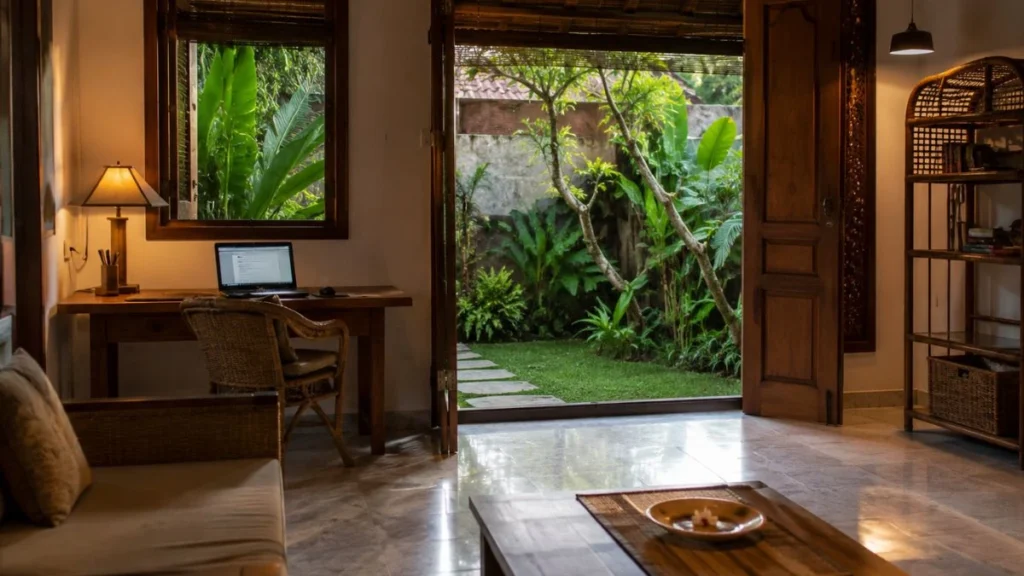
Long stay bali monthly rental tips: The single most impactful decision for a long stay in Bali is not which platform you use to find accommodation — it is whether you negotiate directly with the owner after arriving, rather than booking through a platform before you land. The difference in price for the same villa can be 30–50%.
These long stay Bali monthly rental tips are for visitors planning to stay one month or longer — a period long enough that getting the accommodation decision right from the start matters considerably more than it does for a two-week holiday. The Bali long-stay rental market in 2026 is larger, more varied, and more price-differentiated than it has ever been. It is also more prone to the three specific overpayment traps that this guide covers directly.
For the broader financial picture of what a long stay actually costs beyond accommodation, the cost of living Bali 2025 expat breakdown covers monthly budgets across all expense categories. This guide focuses specifically on the accommodation decision — how to find it, how to negotiate it, and what to check before you sign anything.
The Three Overpayment Traps
Before the practical advice, three pricing traps that catch the majority of first-time long-stay renters in Bali:
Trap 1 — The Canggu premium. Current 2026 market rates place one-bedroom villas in Canggu at IDR 12–18 million per month. The same quality of accommodation in Sanur or the northern Ubud outskirts runs IDR 6–10 million. The difference is not in the villa — it is in the area’s perceived status among the digital nomad community. Paying 40–50% more for a Canggu address is a choice, not a necessity.
Trap 2 — Peak season timing. July–August and the year-end holiday stretch (December–January) are the most expensive months to start a long-stay rental in Bali. Landlords know demand is highest and hold prices accordingly. Starting a lease in May, September, or February produces noticeably better rates for the same property.
Trap 3 — Month-to-month flexibility. The convenience of a month-to-month arrangement costs more than a six or twelve month commitment — often significantly more. A villa listed at IDR 15 million per month on a month-to-month basis may negotiate to IDR 10–11 million on a six-month commitment paid upfront. If you know you are staying for three months or more, a longer commitment almost always produces a better rate.
How Bali Rentals Actually Work: The Market Structure
Understanding the market structure prevents most of the confusion that first-time long-stay renters experience.
Platform listings (Airbnb, Booking.com, Agoda) — these are the highest prices available for any given property. Platform commissions of 15–25% are factored into the listed rate. Long-stay discounts of 20–40% are often available through the platform’s monthly rate function, but the baseline is still higher than direct negotiation produces.
Direct negotiation after arrival — the most effective approach for stays of one month or longer. Arrive in Bali on a short-term booking, spend three to five days walking the areas you are considering, visiting properties in person, and negotiating directly with owners or managers. Properties that have been vacant for two weeks respond differently to negotiation than properties that booked up last month.
Property agents — useful for higher-end villas in the IDR 15–30 million per month range, where the inventory is not fully visible online. A good Bali-based property agent can access unlisted properties and negotiate on your behalf. The agent fee is typically paid by the landlord rather than the tenant, though this varies.
Community platforms — Facebook groups (Bali Housing, Bali Expat Network, Canggu Community) consistently list properties at below-platform rates, often directly from owners or departing tenants subletting the final months of their lease. Updated daily. The listings require quick response — good value properties move within hours.
Co-living spaces — a legitimate mid-point between hotel and private accommodation, particularly for first-time long-stay visitors who want community infrastructure before committing to a private property. Dojo Bali and Outpost in Ubud are the most established. Monthly rates typically IDR 6–12 million including coworking access, high-speed internet, and social programming. Private rooms rather than private villas, but the infrastructure is purpose-built for remote workers.
What to Look for in Any Long-Stay Property
Internet speed and reliability — the single most important practical consideration for remote workers. Ask for a speed test result before committing. 50 Mbps is the working minimum; 100 Mbps is comfortable; anything marketed as “fast internet” without a specific figure is worth testing yourself. Bali’s fiber infrastructure improved in 2025 but storm-related outages remain common in wet season.
Electricity setup — Bali uses a prepaid electricity token system (PLN token). Find out whether electricity is included in the rent or paid separately. If paid separately, ask what the average monthly spend is for the property — an air-conditioned villa running AC through the night can add IDR 600,000–1,500,000 per month to your effective rent.
Water source — tap water in Bali is not potable. Properties with a water dispenser refill service (galon delivery) are more practical than properties without. Refill delivery costs IDR 5,000–20,000 per 19-litre gallon.
Air conditioning — essential in south Bali and coastal areas. In highland areas like Munduk or upper Ubud, AC is less necessary. Confirm that AC units are functional, clean, and have been serviced recently.
Swimming pool maintenance — if the villa has a pool, confirm who is responsible for maintenance and at what frequency. An unmanaged pool in Bali’s humidity becomes unusable within weeks. Weekly professional cleaning should be included in the rental.
Lease contract in English — always request an English-language contract regardless of your comfort with Indonesian. Have it reviewed by a local expat or a licensed property agent before signing. The terms around deposit return, early termination, and utility liability are the sections most frequently disputed.
Area-by-Area Rental Rates 2026
Based on current market data:
| Area | Room / Studio | 1-bed villa | 2-bed villa with pool |
|---|---|---|---|
| Canggu | IDR 7–12M | IDR 12–18M | IDR 18–30M |
| Seminyak | IDR 8–14M | IDR 14–22M | IDR 22–35M |
| Ubud (outskirts) | IDR 5–9M | IDR 9–15M | IDR 14–22M |
| Sanur | IDR 5–8M | IDR 8–14M | IDR 13–20M |
| Sidemen / Candidasa | IDR 2–5M | IDR 5–9M | IDR 8–14M |
| Amed / Munduk | IDR 1.5–4M | IDR 4–8M | IDR 7–12M |
All figures in IDR per month. These are negotiated direct rates — platform rates are typically 20–40% higher.
Negotiation: How to Do It Without Offending Anyone
Bali rental negotiation is expected, not rude. Landlords build negotiating room into their asking prices precisely because negotiation is part of the process. The approach that works:
Arrive and inspect before negotiating. Visit the property in person. Point out any maintenance issues — a dripping tap, a broken screen door, a pool that needs cleaning. These are legitimate reasons for a lower rate and give you something specific to discuss rather than simply asking for a discount.
Make a specific offer. “What is your best monthly rate for a six-month commitment?” is more effective than “can you do it cheaper?” Specificity signals that you are a serious tenant rather than a casual enquirer.
Offer an upfront payment. Bali landlords strongly prefer tenants who pay multiple months upfront — it removes their collection risk. Offering three or six months upfront in exchange for a 10–20% discount is a legitimate negotiating position and is accepted frequently.
Walk away if the number is not right. There are thousands of long-stay properties in Bali. If a landlord will not move from a rate that does not work for you, the next property will. The willingness to leave is the most effective negotiating position available.
The Visa Question: What You Need for a Long Stay
A long stay rental without the correct visa creates unnecessary legal risk. The relevant visa options for long stays:
B211A Social Visit Visa — up to 180 days, single entry, must be obtained before arriving. Cannot be renewed but can be followed by a new application after departure.
E33G Remote Worker KITAS — one year, multiple entries, requires formal employment contract with a foreign company and minimum USD 60,000 annual income. The Bali digital nomad visa E33G guide covers the full process.
Five-year Digital Nomad Visa — launched mid-2025, costs IDR 15 million upfront, averages IDR 250,000 per month when spread across the full term. Requires proof of remote income and health insurance. Provides multiple-entry residency for five years. Still being processed through a relatively new administrative framework — confirm current requirements with a licensed visa agent before applying.
Working remotely on a tourist visa or Visa on Arrival remains illegal regardless of how many people do it. The enforcement trajectory in 2026 is toward stricter compliance, not looser. Factor the correct visa cost into your monthly budget from the start.
Practical Checklist Before Signing
Before committing to any long-stay rental:
Internet speed test — conduct it yourself with Speedtest.net, not a screenshot from the landlord. Electricity bill review — ask to see the last three months of PLN token top-up history. Water situation confirmed — dispenser delivery available? Water pressure adequate? Pool maintenance schedule confirmed — who does it, how often, included in rent? AC units tested — run every unit for ten minutes. Check that they cool effectively and do not produce unusual sounds. Lease contract in English — review deposit terms, utility liability, early termination conditions. Neighbours assessed — spend thirty minutes in the property at different times of day. Listen for roosters, dogs, construction, or nightlife noise. Scooter parking — confirmed and covered if possible. Backup power — does the property have a generator or inverter for power outages?
Ines had spent three days on Airbnb comparing villas before her Bali trip and had bookmarked twelve properties. When she arrived she found a villa she liked on the Facebook Bali Housing group, visited it the same afternoon, and negotiated directly with the owner — a Balinese family renting out the front portion of their compound. The agreed rate for three months was IDR 8 million per month, approximately 35% less than the equivalent property on Airbnb, utilities included, with the family’s compound temple visible through her kitchen window and fresh canang sari outside her door every morning. She extended for three more months without renegotiating. The landlord had not changed the price anyway.
FAQ
How much does a monthly rental cost in Bali in 2026?
A one-bedroom villa in a mid-range area like Sanur or the Ubud outskirts costs IDR 8–14 million per month through direct negotiation. Canggu commands a premium — IDR 12–18 million for equivalent accommodation. Rural East Bali (Sidemen, Candidasa) and North Bali (Amed, Munduk) offer the lowest rates: IDR 4–9 million for a one-bedroom villa. Platform rates on Airbnb and Booking.com are typically 20–40% higher than direct negotiated rates.
Is it better to book a long-stay villa in Bali before arriving or after?
After, for stays of one month or longer. Arriving on a short-term booking, spending three to five days inspecting properties in person, and negotiating directly with owners consistently produces better rates and better decisions than remote booking. Platform listings are the most expensive prices in the market. Direct negotiation after inspection is how long-term residents and experienced nomads find accommodation.
Do I need a visa for a long stay in Bali?
Yes. Working remotely or staying longer than 30 days on a Visa on Arrival is not legally permitted. The B211A Social Visit Visa allows up to 180 days; the E33G Remote Worker KITAS allows one year for employed remote workers; the five-year Digital Nomad Visa launched in mid-2025 provides a longer-term pathway. Factor visa costs into your monthly budget from the start. The Bali KITAS vs tourist visa guide explains the differences between each option.
Can I negotiate the price of a long-stay rental in Bali?
Yes — and you should. Negotiation is expected in the Bali rental market. Offering a longer commitment (six months vs one month) or upfront payment (three months at once) in exchange for a lower monthly rate is standard practice and accepted frequently. A 10–20% reduction from the asking price is achievable in most cases, particularly outside peak season and on properties that have been available for more than two weeks.
What should I check before signing a long-stay rental agreement in Bali?
Test internet speed yourself with Speedtest.net. Review three months of electricity top-up history. Confirm pool maintenance responsibility and frequency. Test all AC units. Review the lease contract in English with specific attention to deposit terms, utility liability, and early termination conditions. Spend time in and around the property at different times of day before committing.