
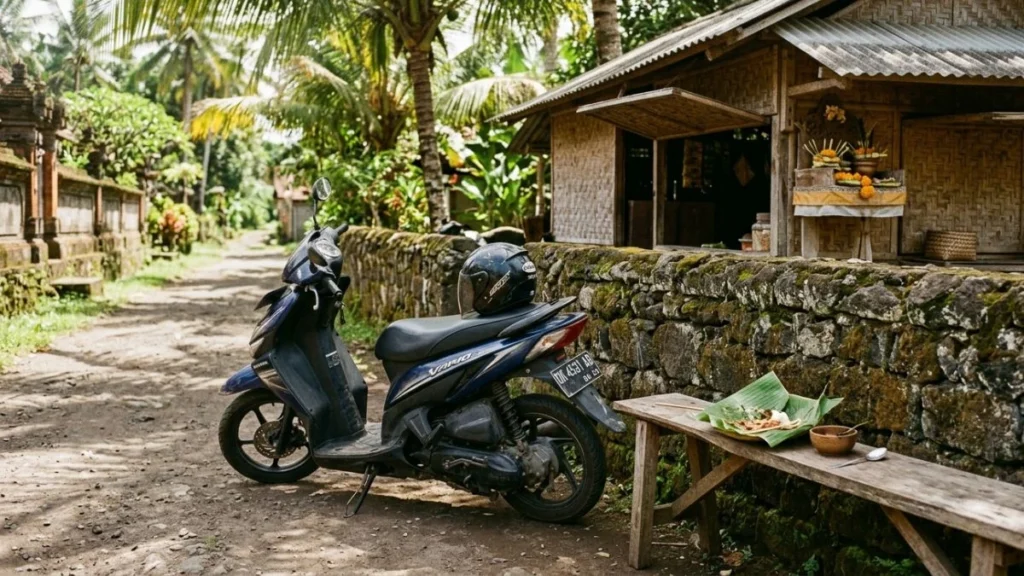
How to get around Bali without a tour: Six transport options cover independent travel in Bali — scooter rental, private driver, Grab and Gojek, Blue Bird taxi, Trans Metro Dewata bus, and shared bemo minibuses. Each serves a different need, area, and budget. Using all six strategically is more practical than committing to one.
Knowing how to get around Bali without a tour is the single most useful piece of practical knowledge for independent travel on the island — because Bali has no reliable public transport network covering tourist areas, and the gap between “figuring it out” and “getting stuck” comes down to knowing which option works in which context. This guide covers all six realistic transport methods, where each one works, what each costs, and the situations where each one fails.
The honest starting point: Bali is not a good island for spontaneous independent transport. It rewards planning. Knowing your options before you arrive — not after you land at Ngurah Rai and someone approaches you in the arrivals hall — changes the entire experience. The Bali entry requirements checklist covers what you need sorted before landing. This guide covers what happens after.
Option 1: Scooter Rental — The Most Flexible, Most Misused
A rented scooter gives you complete independent access to almost every part of Bali. You stop where you want, leave when you want, and reach roads that no car and no driver will take you down without specific instruction. For slow travellers spending more than a week in one or two areas, it is the most practical and cost-effective option available.
Cost: IDR 70,000–100,000 per day for a standard automatic scooter (Scoopy, Vario, or Beat). Monthly rate: IDR 700,000–1,200,000. Fuel: approximately IDR 20,000–30,000 per day for typical tourist-area riding.
What it covers well: Ubud and surrounding villages, East Bali (Sidemen, Tirta Gangga, Amed coastal road), North Bali (Munduk, Lovina approach), and anywhere the road is too narrow for a car to pass comfortably.
What it does not cover well: Airport transfer (scooter + luggage is impractical), south Bali traffic corridors (Seminyak, Kuta, Canggu at peak hours), and any situation where you need to carry more than a day bag.
Legal requirement: An international driving permit (IDP) endorsed for motorcycles is legally required. Police checkpoints targeting unlicensed riders operate regularly on tourist routes — Ubud, Canggu, and near major temples. Carry the IDP. The document verification process takes under two minutes with the correct permit; the fine and negotiation without one takes considerably longer.
Scooter damage scam: Photograph all existing scratches, dents, and damage before riding — front, back, both sides. Send the photos to yourself immediately to create a timestamp. This is the most effective defence against the pre-existing damage claim on return. The full scam mechanics are covered in detail in what to watch out for when renting transport in Bali.
Option 2: Private Driver — The Most Underrated for Day Trips
A private driver for a full day costs IDR 400,000–700,000 from most Bali bases — roughly USD 25–45. For a group of two to four people, this is cheaper per person than most organised tour packages covering the same destinations, with the additional benefit that you control the schedule, the stops, and the pace.
What a private driver provides: A car (usually a Toyota Avanza or Innova), a driver who waits at each stop however long you need, local knowledge of roads and alternatives when the main route is congested, and the ability to change plans mid-day without penalty.
What a private driver does not provide: Cultural interpretation or guide-quality commentary. If you want someone to explain what you are looking at, hire a licensed guide separately at the specific destination. The driver’s job is transport and logistics.
How to find a reliable driver: Ask your accommodation first — guesthouses and small hotels with Balinese staff maintain relationships with local drivers they can vouch for. This is more reliable than street approach or platform booking for a first driver. For repeat use, arrange directly with the driver by WhatsApp for subsequent days.
For East Bali circuits: A driver is the practical choice for the Sidemen–Tirta Gangga–coastal road–Amed route because the narrow coastal section south of Amlapura requires local knowledge of passing points and road conditions. The full circuit detail is in the East Bali self-drive guide.
Option 3: Grab and Gojek — The Right Tool for Urban Areas
Grab and Gojek are Indonesia’s dominant ride-hailing apps and they work well in Bali’s main urban and tourist areas. The apps show the fare before you confirm, drivers are rated, and the pickup and payment process is standardised. For visitors who do not want to rent a scooter or negotiate taxi prices, they are the most straightforward daily transport option in south Bali.
Where they work reliably: Seminyak, Canggu, Kuta, Sanur, central Ubud, Denpasar, and the airport.
Where they are unreliable: Rural East Bali (Sidemen, Amed, Candidasa), North Bali (Munduk, Lovina), and any area where driver density is too low to guarantee availability. In Sidemen, requesting a Grab or Gojek can produce a 45-minute wait or no response at all.
Airport pickup: Both apps have designated pickup zones inside Ngurah Rai terminal — clearly signposted. This is the most straightforward way to get from the airport without negotiating with unlicensed drivers in the arrivals hall. Book the ride before you exit baggage claim.
Gojek vs Grab: Gojek is stronger in rural areas and for food delivery. Grab has slightly more consistent driver availability in south Bali tourist corridors. Both apps are worth having installed — use whichever has the lower fare and shorter wait at any given moment.
Cost: A typical 15-minute ride in south Bali costs IDR 25,000–50,000. Airport to Ubud: IDR 150,000–250,000 depending on traffic surcharge.
Option 4: Blue Bird Taxi — For Specific Situations Only
Blue Bird is Bali’s only reliably metered taxi operator. The taxis are light blue with the bird logo. The meter runs from the moment you enter. There is no negotiation, no fixed-price guessing, and no fare disputes on arrival because the meter is visible throughout.
When Blue Bird is the right choice: When Grab and Gojek are unavailable or surging, when you have heavy luggage, and when you are in an area where metered taxis are the practical option (Denpasar city, near major hotels in Nusa Dua).
When it is not: Blue Bird is less available than Grab or Gojek in most tourist areas, and more expensive for longer routes where app-based pricing is more competitive.
How to identify: Only flag or use cars that are clearly Blue Bird — light blue exterior with the bird logo and a visible meter. Other taxis operating in Bali without meters will quote fixed prices that are almost always higher than Blue Bird metered rates for equivalent journeys.
Option 5: Trans Metro Dewata — The Budget Option with Real Limitations
Trans Metro Dewata is Bali’s public bus system, expanded significantly in 2024–2025. Flat fare of IDR 4,400 per trip with tap-to-pay using a Flazz or e-money card. Air-conditioned. Routes cover Denpasar, Sanur, Kuta, Seminyak, and a Denpasar–Ubud corridor.
Who it works for: Budget travellers staying in south Bali who do not mind adapting their schedule to bus frequency, and commuters moving between Denpasar and Ubud for a specific trip.
Who it does not work for: Anyone trying to reach East Bali, North Bali, temples, rice terraces, or any attraction outside the core urban corridor. The route network is designed for local commuters, not tourist itineraries.
Practical note: Information about routes and schedules is primarily in Indonesian. Download the Teman Bus app for route maps. The system is improving — route additions are planned — but as of 2026 it does not replace other transport options for most tourist purposes.
Option 6: Shared Bemo — For the Experience, Not the Efficiency
Bemo are shared minibuses operating fixed informal routes between towns and villages. They wait until full before departing, have no published schedules, and charge fares negotiated at boarding — typically IDR 5,000–20,000 for short hops.
They are genuinely the cheapest transport option in Bali and genuinely the least predictable. A bemo from Ubud terminal to Gianyar might take 20 minutes or two hours depending on when it fills. They do not serve most tourist destinations directly and require local knowledge of routes and transfer points.
Practical use case: Solo travellers with flexible schedules and light luggage who want to travel between towns the way local residents do. Specifically useful for the Ubud–Gianyar–Klungkung corridor and for reaching bemo hubs where onward connections are available. Not useful for reaching Sidemen, Amed, or any destination outside main town networks.
The Transport Decision Matrix
| Situation | Best option |
|---|---|
| Airport to accommodation | Pre-booked transfer or Grab/Gojek from official pickup zone |
| Daily movement in south Bali | Grab/Gojek or scooter |
| Ubud and surroundings | Scooter |
| East Bali circuit (Sidemen, Amed, Tirta Gangga) | Scooter or private driver |
| North Bali (Munduk, Lovina) | Scooter or private driver |
| Day trip from Ubud to major temples | Private driver |
| Budget urban movement in Denpasar–Ubud corridor | Trans Metro Dewata |
| Travelling between towns on a tight budget | Bemo + patience |
| Group of 3–4 people, full day | Private driver (most cost-effective per person) |
The Combination That Works for Most Independent Travellers
No single transport option covers all of Bali independently. The combination that works for most visitors spending a week or more:
Scooter as daily transport in the area where you are based — Ubud, Sidemen, Amed, or Munduk. Covers everything within 30–40km of your base.
Private driver for full-day circuits that involve multiple stops, long distances, or routes with logistical complexity — East Bali, North Bali, or temple-heavy days.
Grab or Gojek for urban convenience — airport, evenings in south Bali, and any situation where riding a scooter in traffic is more stress than it is worth.
The three together cost roughly IDR 100,000–200,000 per day in total transport — less than most organised day tours and with significantly more flexibility.
Sione had spent his first three days in Bali being collected by a driver at 8am and returned by 6pm, which worked, but left him with no way to be anywhere before 8am or after 6pm. On day four he rented a scooter. By day five he had found a swimming hole behind a rice field that did not appear on any map, had breakfast at a roadside warung because the smell coming out of it at 7am was too good to ignore, and had stopped at a roadside temple for twenty minutes because the gate was open and no one else was there. The scooter did not change his itinerary. It changed his relationship to the island.
FAQ
Do I need a driving licence to rent a scooter in Bali?
Yes. An international driving permit endorsed for motorcycles is legally required. Police checkpoints specifically targeting unlicensed riders operate regularly on tourist routes. Carry the permit every time you ride — the verification process with the correct document takes under two minutes.
Is Grab or Gojek available everywhere in Bali?
No. Both apps work reliably in south Bali tourist corridors and central Ubud. In rural areas — East Bali, North Bali, Munduk, Sidemen, Amed — driver availability is low to nonexistent. Do not rely on either app as your primary transport option if you are based outside the main tourist areas.
How much does a private driver cost in Bali?
IDR 400,000–700,000 for a full day from most Bali bases, covering the driver and vehicle. For a group of two to four people, this is often cheaper per person than equivalent organised tours. Arrange through your accommodation for the most reliable option.
Is public transport available in Bali?
Limited. Trans Metro Dewata covers the Denpasar–Kuta–Sanur–Seminyak–Ubud corridor with air-conditioned buses at IDR 4,400 flat fare. It does not serve most tourist attractions or destinations outside the urban core. Shared bemo minibuses cover inter-town routes but operate on informal schedules.
What is the cheapest way to get around Bali?
Trans Metro Dewata for routes it covers. Shared bemo for inter-town travel with flexibility on timing. A scooter rental (IDR 70,000–100,000 per day) is the cheapest independent option for covering significant distances and reaching places outside the bus network.