
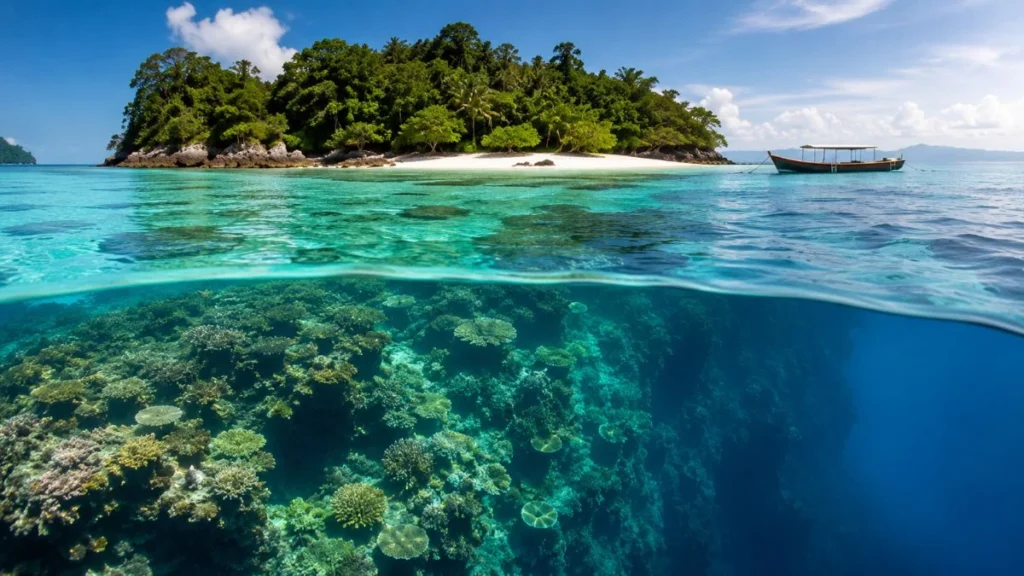
Menjangan Island sits inside West Bali National Park at the island’s far northwestern tip, and it’s easily one of the least-visited places covered in this entire site — not because it isn’t worth the trip, but because getting there takes real commitment. Wall diving with 50-metre visibility, wild deer roaming an uninhabited island, and the only place left on Earth where Bali starlings still fly genuinely wild all sit inside a single protected national park most travelers never make it to.
This guide covers what a visit actually involves, the honest permit and fee system, and whether the distance from Ubud makes sense for your trip.
Quick Facts
- Location: far northwest Bali, straddling Buleleng and Jembrana regencies
- Distance: roughly 100 km from the airport, typically a 3–4 hour drive; expect similar or slightly longer from Ubud
- Access: boat only from Labuhan Lalang or Teluk Terima, a 20–40 minute crossing to the island itself
- You cannot visit independently: a park-registered guide and entrance permit are mandatory
- Fees: park entrance IDR 200,000 (weekday) / 300,000 (weekend), plus separate diving or snorkeling permits, guide fee, and boat charter — costs stack up quickly, so budget more than the base entrance suggests
Why This Requires More Commitment Than Most Bali Nature Sites
Unlike a waterfall or rice terrace you can simply drive to, West Bali National Park operates as a genuinely protected area — you check in at a park ranger office (Cekik near Gilimanuk, or Labuhan Lalang on the north coast), arrange a mandatory guide, and pay a layered set of fees before a boat takes you out to the island itself. Nothing is sold on Menjangan Island once you arrive — no food, no drinks, no shop — so pack water and snacks before boarding, since there’s no way to buy anything once you’re there.
The fee structure is genuinely layered rather than one flat price: the base park entrance runs IDR 200,000 on weekdays or 300,000 on weekends, with additional diving or snorkeling permits (reported anywhere from IDR 15,000–150,000 depending on the source and activity), a guide fee (commonly IDR 250,000–350,000, negotiable), and a boat charter cost split among your group. Joining an existing group at the ranger station, rather than chartering a private boat solo, is the most reliable way to keep the total reasonable.
What’s Actually Underwater
This is the real draw for most visitors who make the trip: Menjangan is known specifically for wall diving, with underwater cliffs dropping from around 10 to 50 metres, covered in soft corals, sponges, and gorgonian sea fans. Visibility here regularly exceeds 50 metres, among the clearest diving conditions in Bali, and the site is considered suitable for all experience levels — light currents make it approachable for newer divers, while the wall drop-offs and macro life (nudibranchs, pygmy seahorses, small crustaceans tucked into the coral) reward more experienced divers too. Snorkelers get a shallower, still genuinely rewarding version of the same reef, particularly around the Coral Garden site on the island’s north side, where batfish, blue starfish, and giant clams are common sights.
Most divers base themselves in Pemuteran, a small fishing village on the approach to the park that also hosts the largest coral reef restoration project in Indonesia — worth knowing about if reef conservation is part of what draws you to this part of Bali in the first place.
The Island and the Wild Deer
Above water, Menjangan Island itself is uninhabited, roughly 175 hectares of dry forest named for the wild deer (“menjangan” is Indonesian for deer) that migrated here when the island was still connected to the mainland. Alongside the deer, wild chickens, rabbits, and monitor lizards inhabit the island, and the whole place has a genuinely undisturbed feel that’s increasingly rare anywhere accessible in Bali.
One detail worth knowing if you’ve read about Bali’s captive-bred starling conservation programs elsewhere: Teluk Brumbun, within this same national park, is reportedly the only remaining location where wild Bali starlings have continuously flown free, rather than existing only in captive breeding populations. Reaching this specific spot requires the same park entrance and boat arrangement through Labuhan Lalang, and it’s a genuinely different way to encounter this endangered species than the captive breeding displays found elsewhere on the island.
Beyond the Island: The Rest of the Park
West Bali National Park extends well beyond Menjangan itself — mangrove tours through Gilimanuk Bay, savanna trekking, cycling routes, and Banyuwedang’s natural hot springs (also home to grey monkeys and water birds) are all part of the same protected area. Trekking and cycling can be arranged through the park rangers, generally running 6am to 6pm, though an early start requires booking the day before rather than showing up and hoping for availability.
Is It Worth the Distance?
Be honest with yourself here, the same way it’s worth being honest about Blimbingsari or other far West Bali stops: this isn’t a casual add-on to an Ubud-based itinerary. The 3 to 4 hour drive each way, on top of the boat crossing and permit process, means this only really makes sense if you’re already exploring far West Bali or North Bali more broadly — combined with Lovina, Munduk, or a Java ferry crossing at Gilimanuk — or if diving and snorkeling in genuinely uncrowded, high-visibility water is enough of a priority to justify a dedicated trip. For those specific travelers, it delivers something increasingly hard to find anywhere else on the island: quiet, protected nature without a crowd competing for the same view.
FAQ
Can I visit Menjangan Island on my own without a guide?
No. West Bali National Park requires a registered park guide and entrance permit for all visitors — independent access isn’t permitted.
How much does a trip to Menjangan Island cost?
Costs stack in layers: park entrance (IDR 200,000 weekday / 300,000 weekend), a diving or snorkeling permit, a guide fee (roughly IDR 250,000–350,000), and a shared boat charter. Joining an existing group rather than chartering privately keeps the total more reasonable.
How far is Menjangan Island from Ubud?
Realistically a 3 to 4 hour drive to the departure point at Labuhan Lalang or Teluk Terima, followed by a 20–40 minute boat crossing to the island.
What’s the best time of year to visit?
Dry season, roughly April to October, for the clearest water and best diving and snorkeling visibility. Rainy season can cloud the water significantly.
Is there anywhere to buy food on Menjangan Island?
No. Bring water and snacks before you board the boat, since nothing is sold once you’re on the island.
Final Thought
Menjangan Island and West Bali National Park ask for real commitment — distance, permits, layered fees — and reward it with something genuinely rare in Bali: uncrowded nature and some of the clearest diving water on the island. If you’re already exploring the far west or north of Bali, it’s worth the detour. For nearby stops that pair naturally with this part of the island, our Blimbingsari village guide and Lovina dolphin and north coast guide cover the rest of far West and North Bali.