
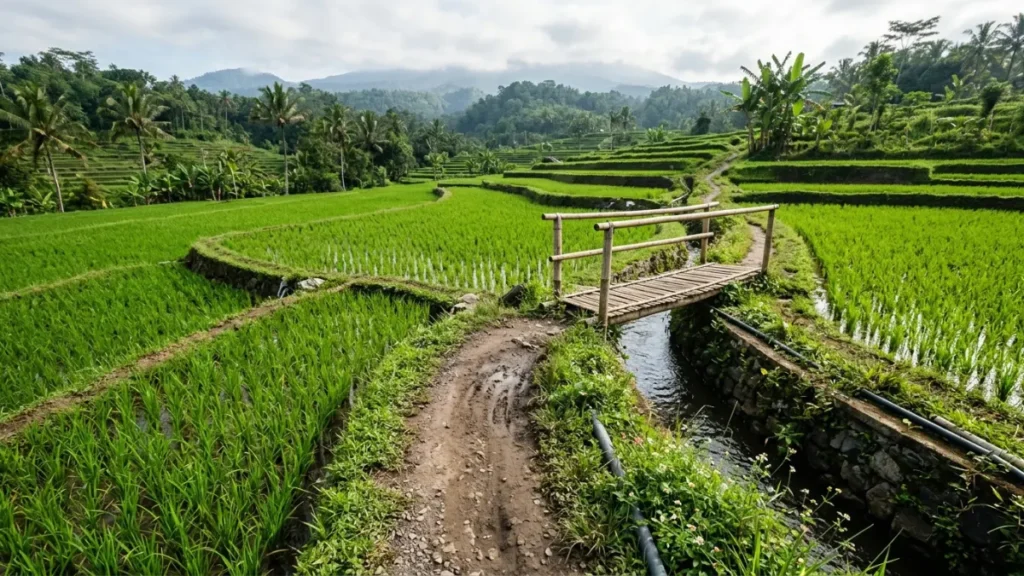
Every rice terrace in Bali runs on some version of the same system: a small official entrance fee, followed by a string of informal “donations” at footbridges, viewpoints, and side paths maintained by individual farmers rather than any central authority. That system exists for a legitimate reason — these are working farms, not municipal parks, and the paths tourists walk on cut directly through land families depend on for income. Most of it is fair. Some of it, especially at the most famous terraces, has drifted into something closer to a toll gauntlet, and knowing the difference before you go saves both money and irritation.
This guide isn’t about any single terrace — it’s the practical layer that applies across all of them, whether you’re headed to Tegalalang for a quick stop from Ubud or driving out to quieter ground like Belimbing or the Soka–Antosari stretch further west.
Quick Facts
- Typical official entrance fee: IDR 15,000–50,000, cash only, pay at the marked booth
- Informal path/bridge donations: IDR 10,000–20,000 is the fair, standard rate — treat requests well above this as a red flag
- Extra-cost add-ons: Swings, photo “nests,” and staged photo props are separately priced (IDR 10,000–350,000) and entirely optional
- What to bring: Small cash notes (5,000 and 10,000 IDR), sturdy shoes with grip, water, mosquito spray
- Best time: Early morning (before 9am) for cooler temperatures, softer light, and fewer tour buses
- Free/donation-only alternatives: Several quieter terraces (Mancingan near Tampaksiring, Soka, Antosari) skip the ticket-booth system entirely in favor of a simple donation box
Why the Fee System Looks the Way It Does
Rice terraces in Bali are maintained through the Subak system — a centuries-old, community-run irrigation network where farmers collectively manage water distribution across their fields. When tourism made these terraces a draw, that same decentralized structure carried over into how visitors are charged: there’s rarely one gate and one price, because there’s rarely one owner. A path might cross three or four different farmers’ land on its way down into a valley, and each one has some claim to a small fee for the privilege of walking through what is, functionally, their farm.
That’s the legitimate version. The complicated version shows up at the busiest sites, where the sheer volume of visitors has turned what should be a modest, once-per-path donation into something some locals have learned to push further than a fair rate — asking for amounts well above the standard 10,000–20,000 IDR, sometimes at multiple points along a single short walk. It’s not universal, and it’s not malicious in the way a scam usually is — but it’s real enough that guides and long-time visitors specifically warn about it at Tegalalang in particular.
The Standard Rate, and When to Push Back
A fair, standard donation for crossing a bamboo bridge or a section of private path is IDR 10,000–20,000. If you’re asked for meaningfully more than that — and it does happen, particularly at high-traffic checkpoints — it’s reasonable to politely offer the standard rate and move on rather than argue or overpay to avoid an awkward moment. This isn’t about being stingy with people whose land you’re walking through; it’s about knowing what “fair” actually looks like so you’re not paying a premium simply because you didn’t know the going rate.
Swings, “nest” photo props, and staged viewpoint installations are a separate category entirely — these are optional tourist attractions bolted onto the terraces, not access fees, and skipping them costs you nothing in terms of the actual rice terrace experience.
What Respectful Actually Looks Like Here
Beyond the money, the terraces are working farms and, in places, sacred ground with small shrines tucked between the paddies. A few things worth keeping in mind that go beyond what a ticket booth will tell you:
- Stay on marked paths and bunds — stepping into the paddies themselves damages young rice plants and the irrigation edges farmers maintain by hand
- Keep voices down near people actually working, rather than treating a farmer mid-task as part of the scenery
- Avoid flying drones near farmers or livestock without checking first — it’s a bigger disruption than it might seem from the ground
- Don’t touch or pick anything — rice, flowers, offerings left at small shrines — even if it looks decorative rather than functional
Where to Go If the Fee Gauntlet Isn’t What You Want
If Tegalalang’s crowds and layered fees sound like more hassle than you want, several alternatives keep the scenery without the toll-booth structure. Mancingan Rice Terrace near Tampaksiring runs on a simple donation box with no fixed entrance fee. Further out, Belimbing and the Soka–Antosari stretch in West Bali operate the same way — free or donation-based, considerably quieter, and closer to how a working rice terrace actually functions day to day rather than how it’s been shaped by high tourist volume.
FAQ
Is it rude to decline a donation request at a Bali rice terrace?
Not if the amount being asked is clearly above the standard rate. Offering the fair 10,000–20,000 IDR rate and moving on is normal practice, not disrespectful — the issue is specifically inflated requests, not the donation system itself.
Do I need cash for rice terraces, or can I pay by card?
Cash only, almost everywhere. Bring small notes (5,000 and 10,000 IDR denominations) specifically, since booths and informal collectors rarely have change for larger bills.
Which rice terraces in Bali don’t charge multiple fees?
Mancingan (near Tampaksiring), Belimbing, and the Soka–Antosari terraces in West Bali generally run on a single donation-box system rather than Tegalalang’s pattern of multiple checkpoints. They’re also considerably less crowded.
What should I wear to visit a rice terrace?
Sturdy, closed shoes with real tread — the clay-based soil on narrow dirt paths gets slick even after light rain, and flip-flops aren’t recommended for anything beyond the paved viewpoints. Light, breathable clothing works fine; there’s no religious dress code at rice terraces the way there is at temples.
Is it worth paying for the Bali Swing at a rice terrace?
That’s a personal call rather than an access requirement — swings and photo “nests” are separately priced tourist attractions layered onto the terrace, not part of seeing the rice fields themselves. Skipping them doesn’t diminish the actual terrace experience.
If a fair-fee, low-crowd terrace sounds like the better fit, Belimbing Rice Terrace and Soka & Antosari are worth reading next — and if you’re comparing the two most famous options first, Jatiluwih vs Tegalalang covers that decision directly.