
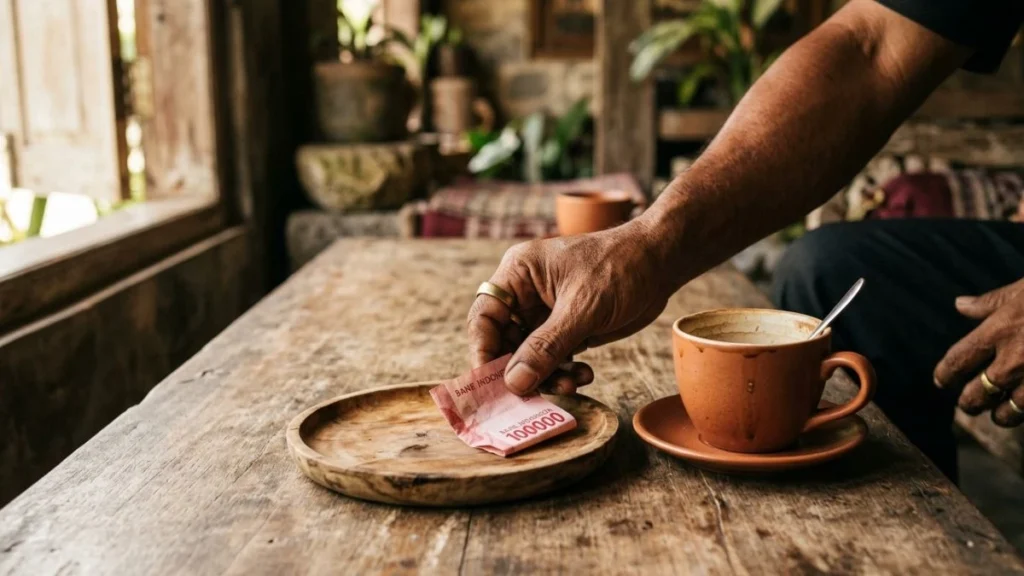
Tipping culture in Bali guide: Tipping is not a native custom in Bali or Indonesia. No one expects it, no one will be offended if you don’t, and the service charge already included in most tourist-facing bills is the formal mechanism for rewarding staff. A small tip for genuinely good service is always appreciated — but it is a gesture, not an obligation.
This tipping culture in Bali guide covers the one thing most visitors get wrong: treating Bali like a tipping-mandatory destination when it is not. Understanding the difference between a service charge (which is already built into most bills at restaurants, hotels, and spas) and a discretionary tip (which is a personal gesture of appreciation) saves you money, avoids double-tipping, and helps you understand what actually happens to the money you leave.
The practical starting point: always check your bill before leaving anything extra. Most mid-range to upscale establishments in Bali add a combined tax and service charge of 15–21% — typically 10% service charge plus 11% government tax. If that line is on your bill, the service has already been compensated. An additional tip is generous but unnecessary unless the service was genuinely exceptional.
Why Tipping Is Not Automatic in Bali
Balinese and Indonesian culture does not have a historical tipping tradition. Unlike the United States — where tipping is effectively a wage subsidy built into the service economy — in Bali, tipping emerged with international tourism and remains concentrated in tourist-facing industries.
Service workers in Bali’s hospitality sector earn modest fixed wages. The minimum wage in Badung regency (which covers Canggu, Seminyak, Kuta, and Nusa Dua) is approximately IDR 3,534,338 per month (around USD 210) as of 2025. In this context, a tip of IDR 50,000 represents roughly 1.4% of a monthly wage — small as a percentage, meaningful as a daily gesture. The staff who benefit most from tips are those in positions where the service charge may not reach them directly: villa housekeepers, private drivers, and independent warung owners.
The Service Charge: What It Is and Where It Goes
The service charge appearing on bills at restaurants, spas, and hotels in Bali is typically 10% of the pre-tax subtotal. It is meant to be distributed to service staff — but the distribution mechanism varies by establishment. In some places it goes into a pool shared across all staff on shift. In others, it supplements base wages without reaching individual servers directly.
If you want a specific person — the server who looked after your table, the therapist who gave your massage, the housekeeper who maintained your room — to receive something directly, a separate cash tip handed to that person is the only way to ensure it. The service charge on the bill does not do this with any certainty.
At warung — local family-run eateries — there is no service charge and no expectation of tipping. These are small-margin businesses, often family-operated, where the person serving you is also the owner. Rounding up the bill or leaving small change is a kind gesture; a formal tip is not part of the transaction.
Tipping by Situation
Restaurants and Cafés
At a warung or local café with no service charge: No tip is expected. Rounding up to the nearest IDR 5,000 or 10,000 is a warm gesture and costs almost nothing.
At a mid-range tourist restaurant with no service charge listed: A 5–10% tip is appropriate for good service. On a IDR 150,000 meal, IDR 15,000–20,000 is more than sufficient.
At a restaurant with service charge already included: No additional tip is required. If the service was genuinely exceptional — a server who went well beyond the expected — leaving IDR 10,000–20,000 directly for that person is a thoughtful gesture, not a social expectation.
Practical note: Pay the bill as printed and leave any tip in cash on the table or hand it directly to the server. Card gratuity options are not standard in Bali. Cash in Indonesian Rupiah is the only reliable method — do not leave foreign coins or small USD bills, which cannot be exchanged and are of no practical value to staff.
Private Drivers
Private drivers are the service category where tipping is most consistently appreciated and most directly impactful. A driver hired for a full day (IDR 400,000–600,000 for the vehicle) is working a physically demanding, long-hours job in traffic. The standard tip for a full day of good service is IDR 50,000–100,000 — handed directly to the driver at the end of the day, not through a booking platform.
For a driver who goes beyond the job description — waits longer than agreed, helps carry luggage, provides genuinely useful local knowledge throughout the day — IDR 100,000–150,000 is generous and well-received.
For Gojek or Grab rides: no tip is expected. Rounding up to the nearest IDR 5,000 is a nice gesture for a long ride or food delivery in difficult weather. The apps have an in-app tipping option which is used by some visitors.
Spa and Massage
Bali’s spa and massage industry is extensive and tip expectations vary by venue type.
Budget massage shops (IDR 80,000–150,000 per hour): A tip of IDR 20,000–30,000 is generous relative to the price point and will be genuinely appreciated.
Mid-range spa (IDR 150,000–350,000 per treatment): IDR 30,000–50,000 per therapist is appropriate for good service.
Upscale resort spa with service charge included: No additional tip is required. If you want to tip the specific therapist who worked with you — which is the meaningful gesture — hand IDR 20,000–50,000 directly to them after the treatment, not at the front desk.
The principle here applies across all service categories: if you want a specific person to receive your appreciation, give it directly in cash. Anything left through a centralised payment system may or may not reach the individual.
Hotel Staff
Housekeeping: IDR 20,000–50,000 per day, left in cash on the pillow or on the bathroom counter with a brief note. Leaving the full amount at checkout means it may not reach the specific person who cleaned your room each day. Daily tipping is more direct.
Bellhop/porter: IDR 10,000–20,000 per bag for luggage assistance. This is a standard practice at hotels where porters assist with luggage as part of their role.
Concierge: For genuine help with a complex arrangement — booking a hard-to-get dinner reservation, organising transport at short notice, managing an unusual request — IDR 50,000–100,000 is appropriate. For standard information or a recommendation, nothing extra is necessary.
Villa staff: Villa stays involve a more personal service dynamic. For a stay of several nights where the villa staff maintain the property and assist throughout, IDR 50,000–100,000 per person per day at the end of the stay is appropriate and well-received. For longer stays, a collective envelope for the team left on departure is a common practice among regular Bali visitors.
Tour Guides
For a licensed guide leading a half or full-day tour with genuine knowledge and engagement: IDR 50,000–100,000 is a reasonable tip for good service. For exceptional service — a guide whose knowledge, language ability, and attention made a meaningful difference to the experience — IDR 100,000–150,000 is appropriate.
Do not tip unlicensed guides who approach you at temple entrances or tourist sites without solicitation. This is covered in the Bali scams guide — unofficial guides operating on commission at major sites are a known tourist trap, and tipping them reinforces the practice.
How to Give a Tip in Bali
Use Indonesian Rupiah. Foreign currency — particularly coins and small USD bills — cannot be exchanged easily and has no practical value to the recipient. Always tip in IDR.
Cash only. Card tipping infrastructure is not standard in Bali. Cash handed directly to the person is the only reliable method.
Hand it with both hands or your right hand. In Balinese and Indonesian culture, giving and receiving money with both hands is a gesture of respect. Tossing a note on a table without eye contact can come across as dismissive regardless of the amount.
Keep it proportionate to the venue. A IDR 50,000 tip at a warung that charged you IDR 35,000 for a meal can feel excessive and create an awkward dynamic. Match the gesture to the scale of the transaction.
Do not tip excessively. Very large tips can make staff feel uncomfortable and may create unrealistic expectations for future visitors at the same establishment. The gesture should be sincere rather than performative.
Lena had been in Bali for three weeks and was still unsure about tipping every time she paid a bill. On her last day she asked the owner of the warung she had eaten breakfast at every morning whether she should have been tipping. The owner laughed and said the food was cheap because it was meant to be — and that Lena coming back every morning was the tip she actually wanted. Lena left IDR 50,000 anyway. The owner accepted it with both hands and a smile and told her to come back next year.
Quick Reference: Tipping Amounts in IDR
| Service | No tip needed | Standard tip | Exceptional service |
|---|---|---|---|
| Warung / local café | ✓ | Round up | IDR 5,000–10,000 |
| Restaurant (no service charge) | — | 5–10% of bill | 10–15% |
| Restaurant (service charge included) | ✓ | — | IDR 10,000–20,000 direct |
| Private driver (full day) | — | IDR 50,000–100,000 | IDR 100,000–150,000 |
| Gojek / Grab ride | ✓ | Round up IDR 5,000 | IDR 10,000 |
| Budget massage (per therapist) | — | IDR 20,000–30,000 | IDR 50,000 |
| Mid-range spa (per therapist) | — | IDR 30,000–50,000 | IDR 50,000–100,000 |
| Resort spa (service charge included) | ✓ | — | IDR 20,000–50,000 direct |
| Housekeeping (per day) | — | IDR 20,000–50,000 | IDR 50,000 |
| Licensed tour guide (full day) | — | IDR 50,000–100,000 | IDR 100,000–150,000 |
| Villa staff (end of stay) | — | IDR 50,000–100,000/day | IDR 100,000–150,000/day |
FAQ
Is tipping expected in Bali? No. Tipping is not a native custom in Bali and service workers do not expect it as a standard transaction. In tourist-facing industries — restaurants, spas, hotels, and private drivers — a tip for good service is genuinely appreciated. In local warung and everyday transactions, it is not expected and not necessary.
What happens to the service charge on my bill? The service charge is meant to be distributed to service staff, but the mechanism varies by establishment. It may go into a shared pool or supplement base wages without reaching individual servers directly. If you want a specific person to receive a tip, give it to them in cash directly.
Should I tip in USD or IDR? Always tip in Indonesian Rupiah. Foreign currency — particularly coins and small denomination USD bills — cannot be exchanged efficiently and has minimal practical value to the recipient. Carry small IDR notes (IDR 10,000, 20,000, 50,000) specifically for tipping.
Is it rude not to tip in Bali? No. Unlike in the United States, where not tipping can be perceived as insulting, in Bali the absence of a tip is the cultural default. Not leaving a tip at a warung or after a routine service transaction is entirely normal and causes no offence.
How much should I tip a private driver in Bali? For a full day of good service, IDR 50,000–100,000 handed directly to the driver at the end of the day is standard. For exceptional service — a driver who provides genuine local knowledge, waits longer than agreed, or assists with difficult logistics — IDR 100,000–150,000 is generous and appropriate.