
What not to do in Bali cultural rules: In March 2025, Bali’s Governor issued Circular Letter No. 7 of 2025 — a formal update to visitor conduct regulations with enforceable penalties. Most of what it prohibits is not new. What is new is the enforcement.
This guide to what not to do in Bali cultural rules covers the behaviours that cause genuine offence to Balinese people, the regulations now formally enforced under the 2025 Governor’s Circular, and the practical distinctions between rules that are enforced at the gate versus those that are matters of respect rather than law. The two categories are different and both matter.
Bali received over 6.3 million international visitors in 2024. The incidents that prompted the 2025 regulatory update — tourists climbing sacred trees, photographing ceremonies without permission, riding scooters without licences, using single-use plastics in protected areas — were not committed by most visitors. They were committed by enough visitors that the provincial government felt compelled to formalise what had previously been understood as social expectation.
The Bali temple etiquette guide covers the specific rules around temple dress and behaviour in more depth. This article covers the broader picture — what not to do across all of Bali, not just inside temple gates.
What the 2025 Regulations Actually Say
Circular Letter SE No. 07 of 2025, issued by Governor I Wayan Koster on 24 March 2025, formally prohibits the following for all foreign tourists in Bali:
- Entering sacred temple inner sanctuaries (utamaning mandala and madyaning mandala) unless worshipping in traditional Balinese attire
- Climbing sacred trees or monuments
- Taking inappropriate or nude photographs at religious sites
- Littering or polluting beaches, rivers, lakes, or the ocean
- Using single-use plastics — bags, Styrofoam, straws, and plastic-packaged drinks
- Aggressive or disrespectful behaviour, including swearing, causing disturbances, or sharing hate speech and misinformation on social media
- Working or running a business without official permits
- Trading illegal goods, including protected wildlife, cultural artefacts, sacred objects, or drugs
Enforcement is handled by a newly established task force, Bali’s Civil Service Police Unit (Satpol PP), and local police. Violations can result in fines or deportation under Indonesian law. Tourists and residents can report violations via the official WhatsApp hotline: +62 81-287-590-999.
These are the legal baseline. The cultural rules below go further — they cover what matters to Balinese people regardless of whether enforcement is present.
At Temples and Sacred Sites
Do not enter the inner sanctuary without being invited to worship. The innermost courtyard of a Balinese temple — the jeroan — is for Balinese Hindus conducting prayer. Tourists are welcome in the outer and middle courtyards. The boundary is usually marked and temple staff will direct you. Do not attempt to enter beyond the marked visitor areas regardless of whether anyone appears to be watching.
Do not climb on shrines, statues, or sacred trees. This is now explicitly illegal under the 2025 circular, not just culturally offensive. The incidents that triggered this prohibition — tourists climbing sacred banyan trees and temple structures for photographs — caused significant community distress. The rule is absolute and enforced.
Do not photograph ceremonies from above or at close range. Positioning yourself on a wall or elevated surface to photograph an active ceremony is both disrespectful and prohibited. Photographing worshippers in prayer at close range without acknowledgment is the equivalent of photographing someone in a moment of private religious devotion. The standard is: if you would not do it in a place of worship in your own country, do not do it here.
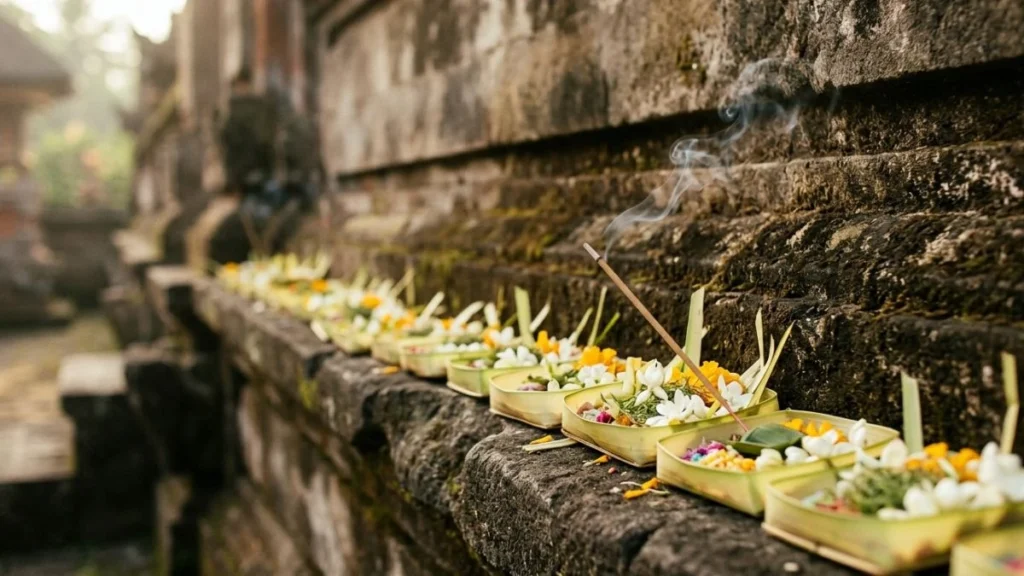
Do not step over offerings. Canang sari — the small woven palm leaf trays filled with flowers, rice, and incense — are placed on the ground as active offerings in communication with the divine. They are not decoration. Walk around them, not over them, even when the street is crowded and it requires a slight detour.
Body Language and Physical Contact
Do not touch anyone’s head. In Balinese Hindu cosmology, the head is the most sacred part of the body — the closest to the divine. Touching a person’s head, including children and babies, is considered deeply disrespectful regardless of the intention. This surprises visitors who habitually tousle children’s hair as a friendly gesture. Do not.
Do not point with your index finger. Pointing at people or sacred objects with a single extended index finger is considered rude across Bali and Indonesia. If you need to indicate direction, use your whole hand with fingers together, or your thumb.
Do not sit with your feet pointing at people or shrines. Feet are the lowest and least pure part of the body. Sitting with feet extended toward a shrine, altar, or another person — particularly an elder or a priest — is disrespectful. Tuck your feet to the side when sitting on the ground in ceremonial or sacred contexts.
Do not use your left hand for giving or receiving. The left hand is considered impure in Indonesian culture. When handing something to someone — money, a business card, food — use your right hand or both hands. This applies in market transactions, restaurants, and any direct exchange.
Environmental Rules — Now Legally Enforced
Do not use single-use plastics. Plastic bags, Styrofoam food containers, plastic straws, and plastic-packaged drinks are banned in Bali under both the 2019 Provincial Regulation and the 2025 circular. This is not aspirational policy — it is enforceable law. Many shops, warung, and accommodation already operate plastic-free by default. Bring a reusable bag, a reusable bottle, and a reusable straw if you use one.
Do not litter. Disposing of waste into rivers, on beaches, or at temple sites carries formal penalties under the 2025 regulations. The visual effect of litter on Bali’s rivers and coastlines is significant and has been a source of ongoing community frustration. Use designated waste bins, and if none are present — which happens in remote areas — carry your waste out.
On the Road
Do not ride a scooter without a valid licence. Indonesian law requires either a valid international driving permit or an Indonesian licence to operate a motorbike. Police checkpoints specifically targeting unlicensed riders are common on tourist routes — Ubud, Canggu, Seminyak, and near major temples. Being stopped without a licence results in a fine, and your scooter may be impounded.
Do not ride without a helmet. Mandatory under Indonesian law. The fine for riding without a helmet is small; the consequence of a collision without one is not. Helmets are provided with all legitimate scooter rentals. Wear it.
Do not drink and drive. This applies universally and is enforced. Bali’s roads — particularly the narrow lanes of central Ubud and the south Bali coastal roads — require full concentration. Road accidents involving tourists under the influence are among the most common serious incidents on the island.
Social Conduct
Do not raise your voice or display anger in public. Balinese culture values composure and calm resolution of disagreement. Losing your temper in public — at a driver, a vendor, a restaurant — causes significant loss of face for the person on the receiving end and reflects badly on the visitor in ways that are difficult to recover from. If something goes wrong, address it quietly and without aggression. A calm, direct conversation resolves most situations; shouting resolves none.
Do not engage unlicensed guides at major temples. This is covered in the Bali scams guide, but it is also a matter of cultural regulation — the 2025 circular specifically requires tourists to use licensed guides at cultural and natural sites. Unlicensed guides operating at Besakih, Tanah Lot, and Uluwatu are a documented problem and their engagement is now formally non-compliant as well as financially risky.
Do not photograph people without permission. This applies everywhere but particularly in village settings, at ceremonies, and in markets. Balinese people are generally patient with tourist cameras, but the courtesy of asking — even with a gesture and a questioning expression — before photographing an individual is both respectful and, in ceremonial contexts, essential.
During Nyepi — Bali’s Day of Silence
Nyepi is the Balinese Hindu New Year, observed as a complete day of silence, darkness, fasting, and stillness. It occurs annually in March or April according to the Balinese Saka calendar. On Nyepi:
- The airport closes — no flights in or out
- All roads are closed — no vehicles, no walking outside
- All lights must be extinguished after dark
- Noise is prohibited
- Tourists must remain in their accommodation for the full 24 hours
Pecalang — traditional Balinese community security guards — patrol the streets and will enforce the silence. The rules apply to all visitors regardless of their own religious background. Nyepi is not an inconvenience to work around — it is the most significant day in the Balinese Hindu calendar and the one where visitor respect matters most.
Check the Nyepi date before booking your Bali trip. If your arrival or departure coincides with Nyepi, your flight will be affected and your first or last day will be spent indoors. Plan around it rather than through it.
Tom had been in Bali for ten days and was proud of how respectfully he’d travelled. On his last afternoon in Ubud, he found himself in a small village lane when a procession appeared — gamelan, offerings, white-clothed worshippers moving toward the temple at the end of the road. He stepped aside, put his phone in his pocket without thinking, and stood quietly as it passed. An older woman near him smiled and nodded. He didn’t know what he’d done right. He’d just done nothing wrong.
FAQ
What are the main things tourists are not allowed to do in Bali in 2025? Under Circular Letter No. 7 of 2025, tourists are prohibited from entering temple inner sanctuaries without proper attire, climbing sacred trees or monuments, using single-use plastics, littering, behaving aggressively in public, working without permits, and trading illegal goods. These carry enforceable penalties under Indonesian law.
Can tourists be deported from Bali for breaking cultural rules? Yes. The 2025 regulations specify that serious violations can result in deportation under Indonesian immigration law. Violations can be reported to the Bali tourism police or via the official WhatsApp hotline at +62 81-287-590-999.
Is it illegal to use plastic bags in Bali? Yes. Single-use plastics including bags, Styrofoam containers, straws, and plastic-packaged drinks have been banned in Bali since the 2019 Provincial Regulation, reinforced by the 2025 Governor’s Circular. Enforcement has increased. Bring a reusable bag and water bottle.
What happens during Nyepi and what do tourists need to do? Nyepi is Bali’s Day of Silence — a full 24 hours during which all roads close, the airport shuts, lights are extinguished, and noise is prohibited. Tourists must remain in their accommodation for the full day. Traditional security guards (pecalang) patrol streets and enforce the silence. Check the Nyepi date before booking — it falls in March or April each year.
Is it disrespectful to photograph Balinese people? Photographing people without asking is considered disrespectful, particularly at ceremonies, in villages, and in markets. A gesture asking permission before photographing an individual is both courteous and, in ceremonial contexts, essential. Photographing the offerings, architecture, and landscape without people in them requires no permission.